

Ramanujan Math Club
Dashboard
10
Activities
0
Members
2
Faculty
36
Gallery Images
About Club
Ramanujan Math Club
Vision
Explore Patterns
Club Body
Faculty Coordinators

SUDHA RANI
Lecturer in Mathematics
Mathematics
Faculty Coordinator

OLLALA ODELU
Lecturer
Mathematics
Faculty Co-Coordinator
Student Members
Activities
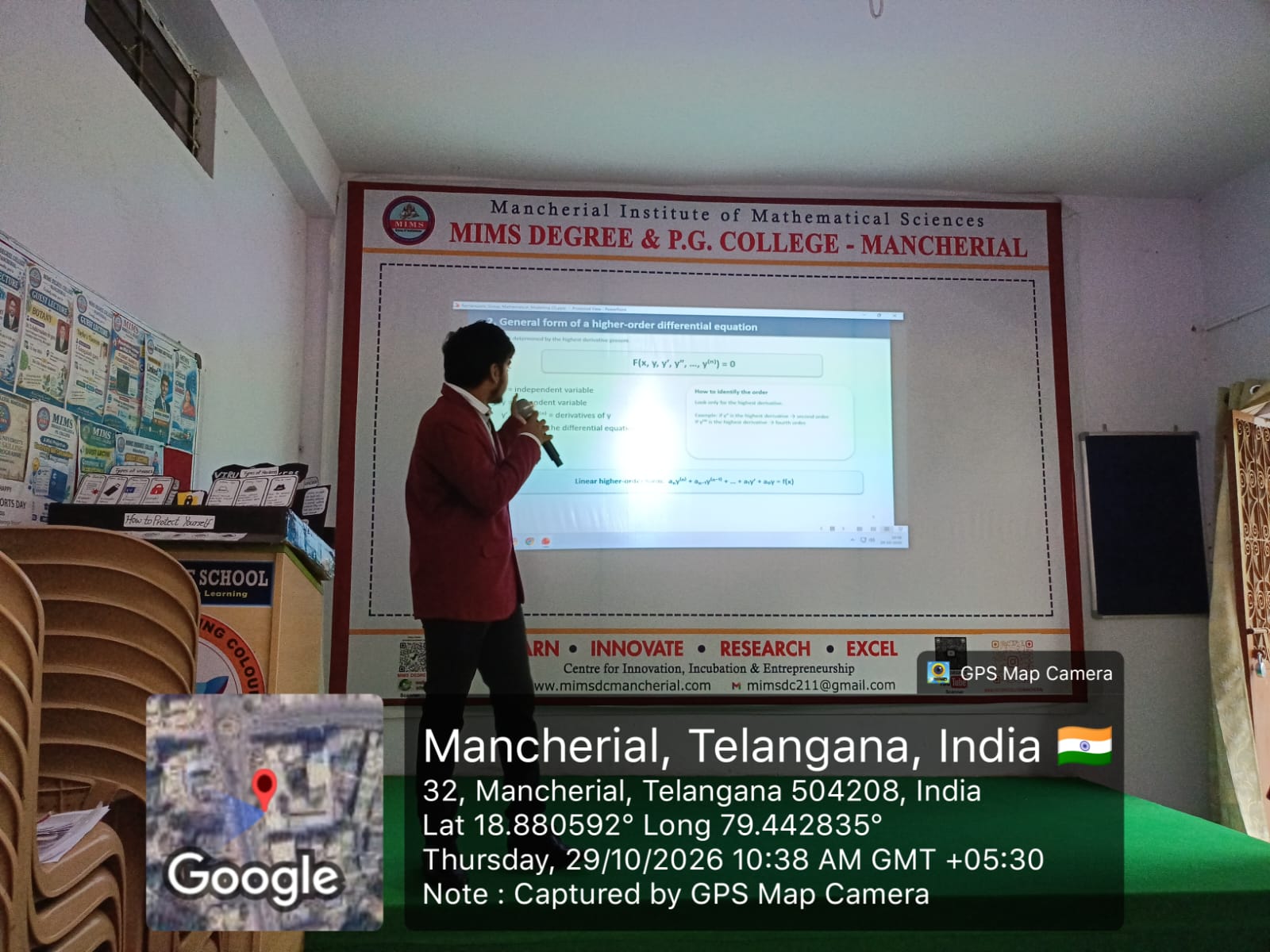
Mathematics Students Seminar on Implicit functions
📅 29 Oct 2026
📍 Class room
🏆 Department
Mathematics Students Project Presentation on Application in Physics and Engineering
📅 29 Oct 2026
📍 Seminar Hall
🏆 Department
Students Project Presentation on Mathematical modelling
📅 29 Oct 2026
📍 Seminar Hall
🏆 Department
Students project Presentation on Basis Generator
📅 29 Oct 2026
📍 Seminar Hall
🏆 Department
Students Project Presentation on vector calculation
📅 29 Oct 2026
📍 Seminar Hall
🏆 Department
Mathematics Behind Bathakamm Ustav
📅 09 Oct 2026
📍 College ground
🏆 Department
Mathematics Students Seminar on Application of Rank nullity theorem in electrical networks
📅 08 Oct 2026
📍 Class room
🏆 Department
Mathematics Students Group discussion on importance of calculus
📅 28 Sep 2026
📍 Class room
🏆 Department
Mathematics Students Group Discussion on Importance of Linear Algebra
📅 22 Sep 2026
📍 Class room
Guest Lecturer on Taylor's Theorem by Mr.T.Gangaiah garu
📅 10 Sep 2026
📍 Seminar hall Mims dc college
🏆 Department
Gallery
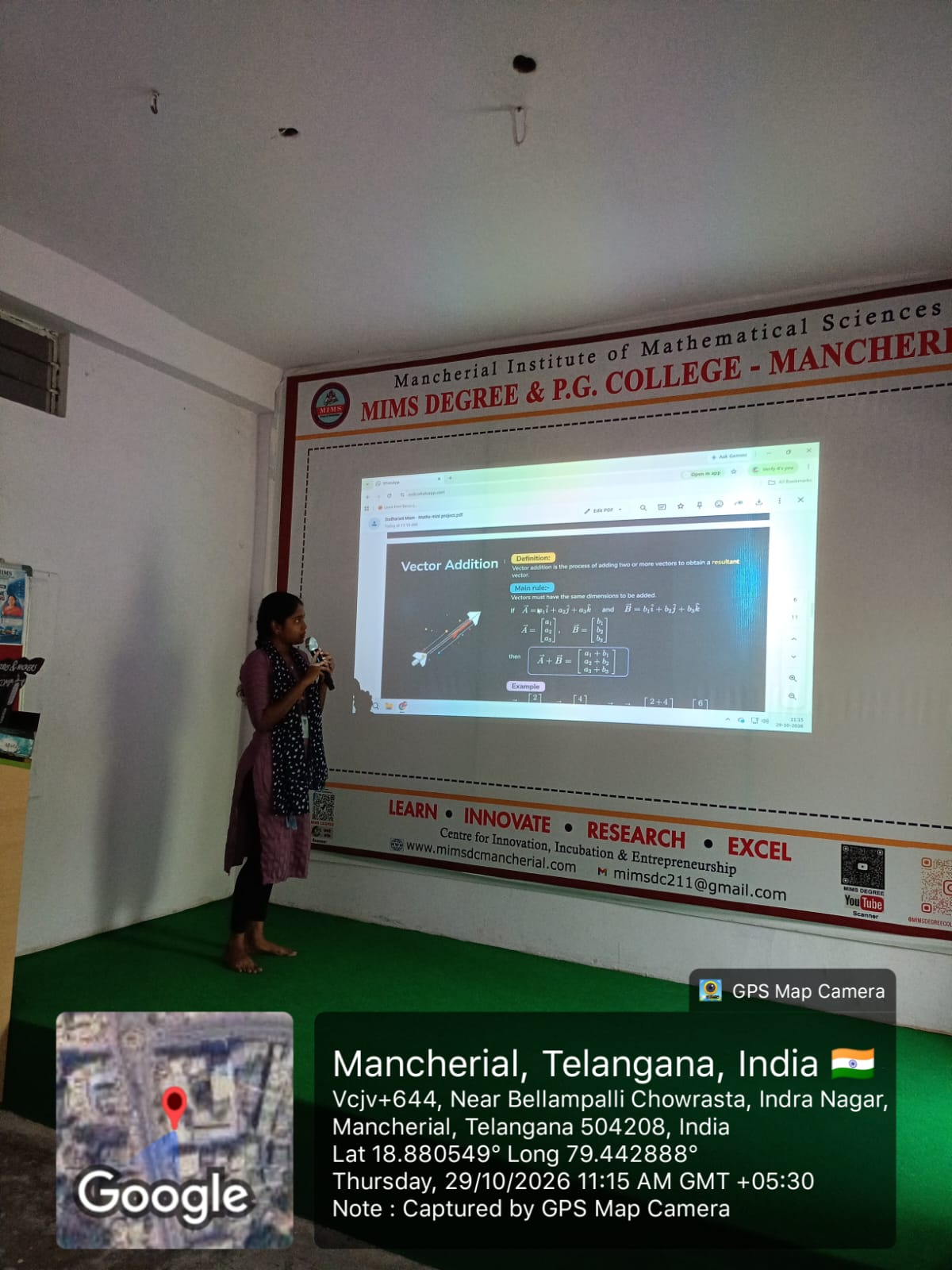
Output & Validation: It delivers precise geometric insights, validating simulated directional data against real-world mechanical behaviors.
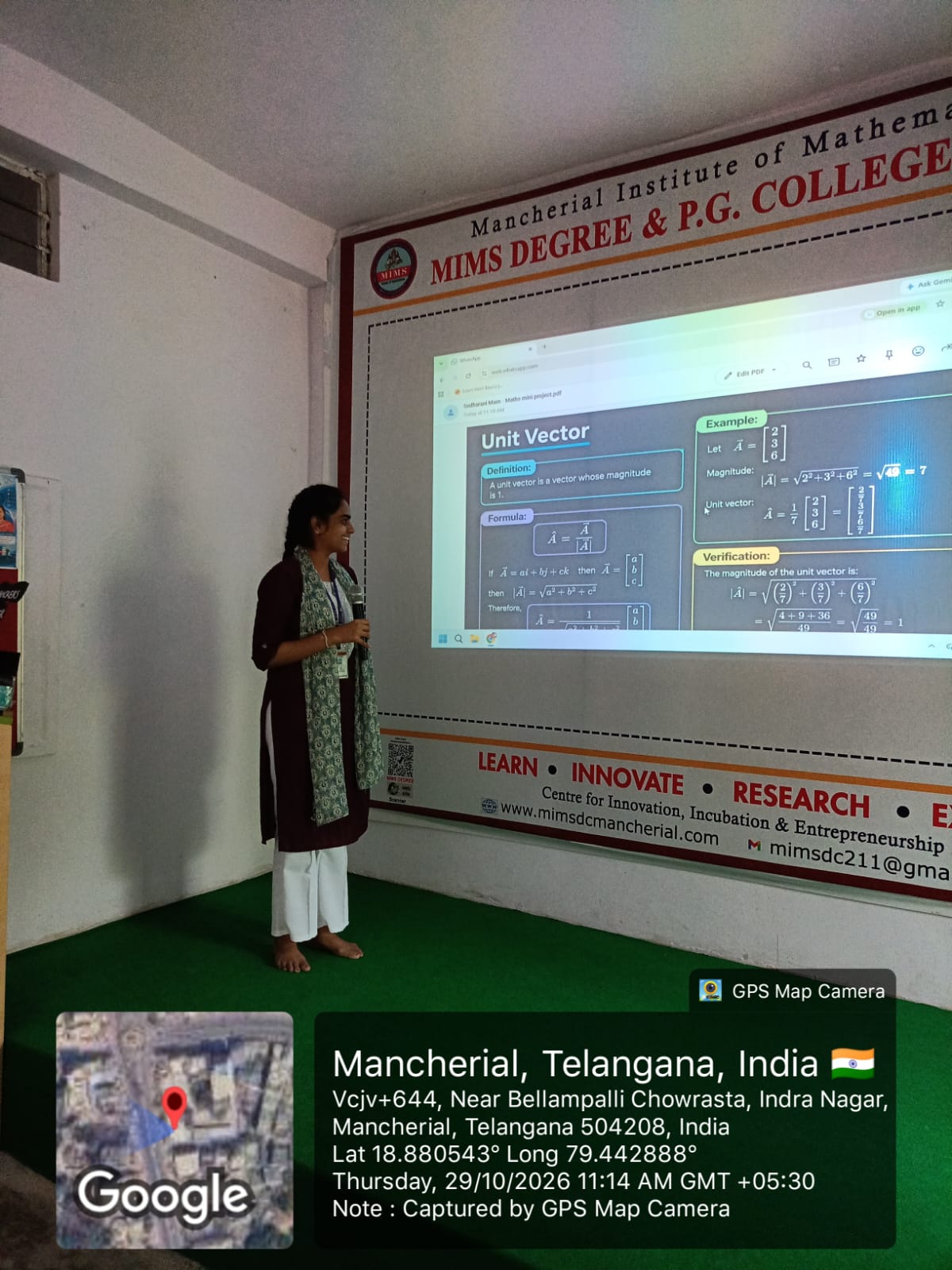
Algorithmic Processing: It employs automated computational routines to rapidly compute angles, vector projections, and cross products.
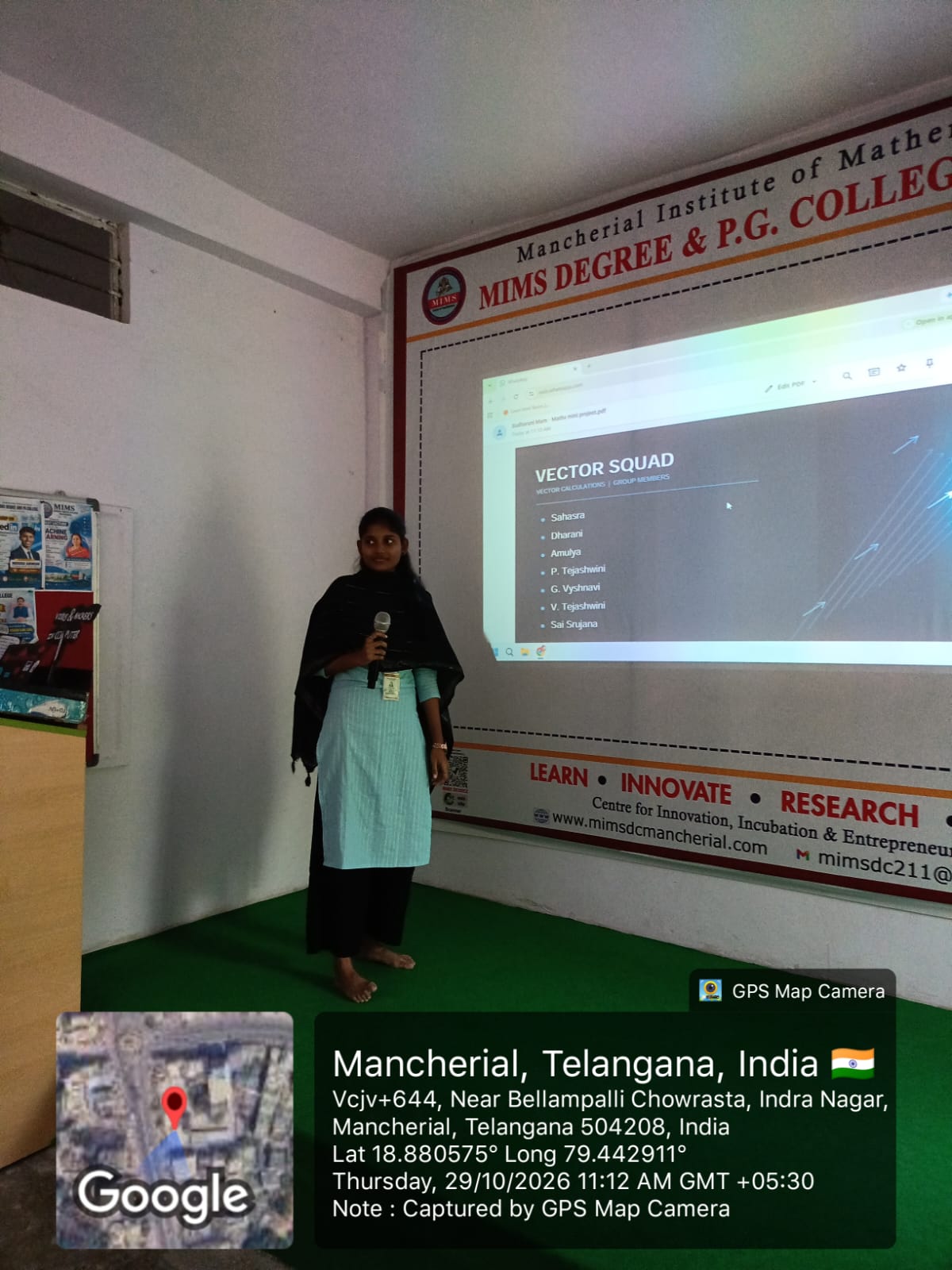
Mathematical Formulation: It translates physical directional attributes and spatial dimensions into numerical vectors and magnitude equations.
Core Utility: By automating this reduction, it transforms unstructured high-dimensional spaces into streamlined coordinate frameworks ready for computation and analysis.
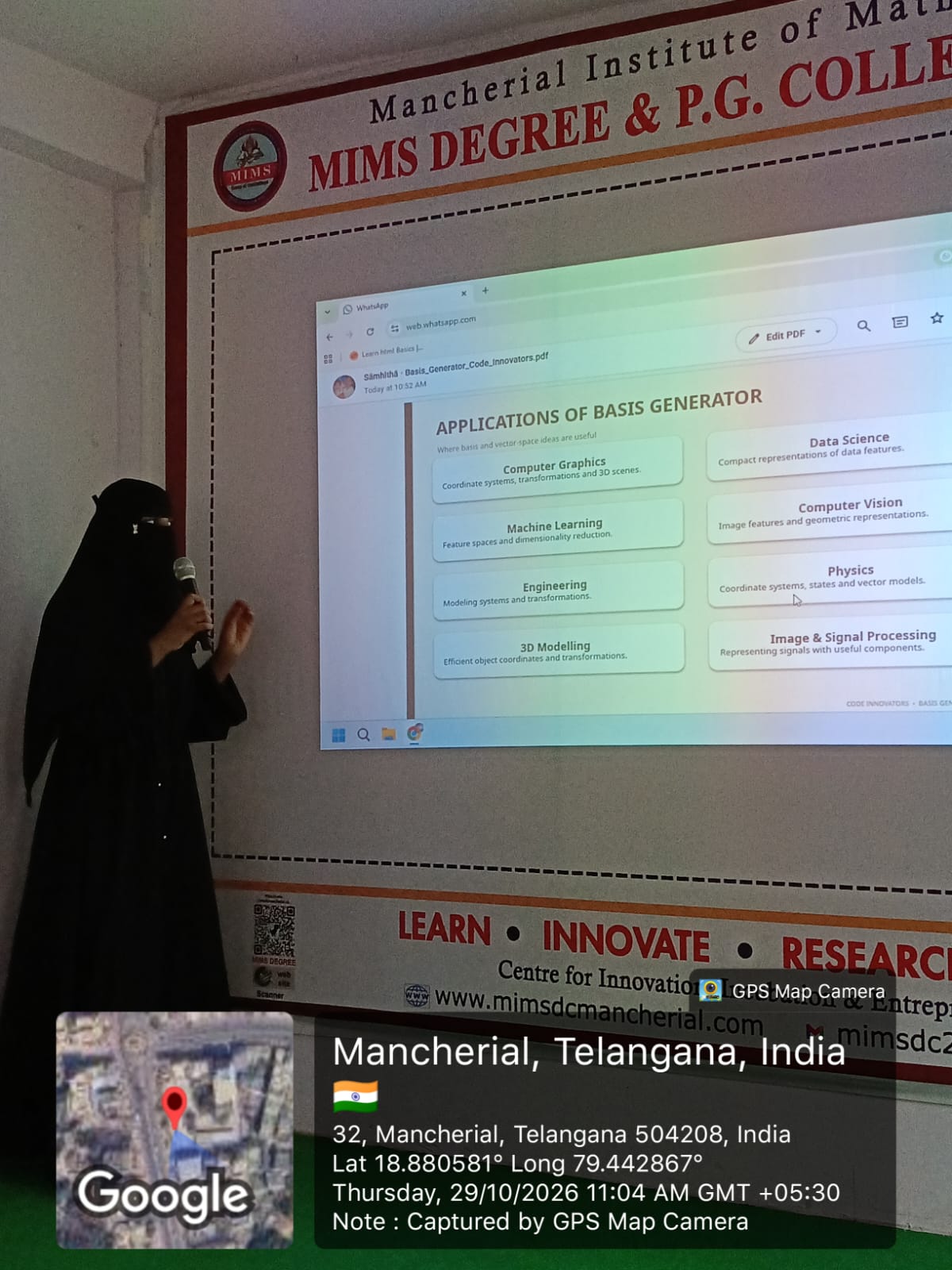
Algorithmic Workflow: The system uses matrix factorization techniques—such as Gaussian elimination or row reduction—to evaluate candidate vectors and filter out dependent duplicates.
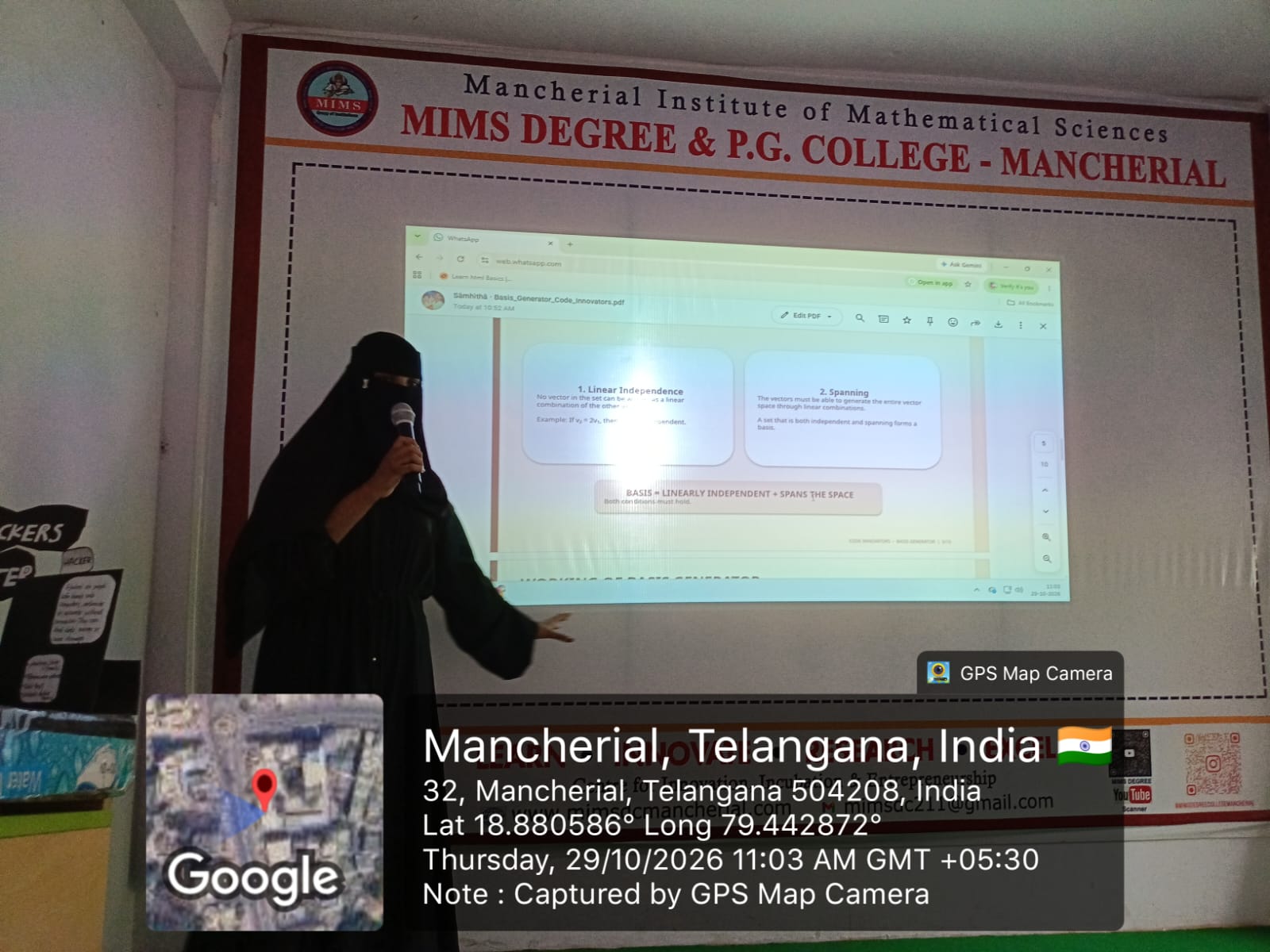
Extraction Mechanism: It is a computational process that sifts through a large, potentially redundant set of vectors to isolate a minimal, linearly independent subset (the basis).
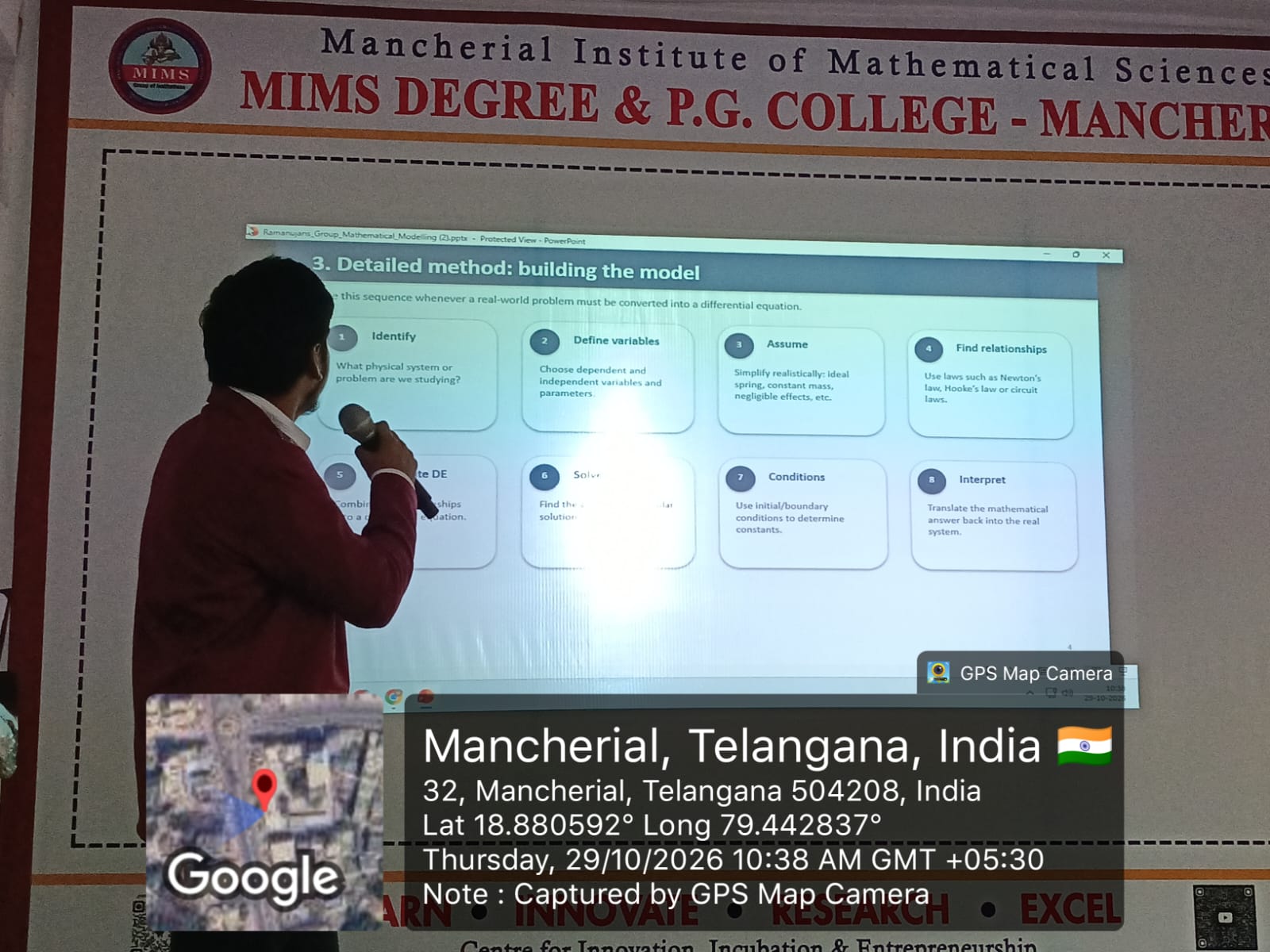
The process concludes by interpreting the mathematical results back into practical solutions, continuously validating and refining the model against real-world data.
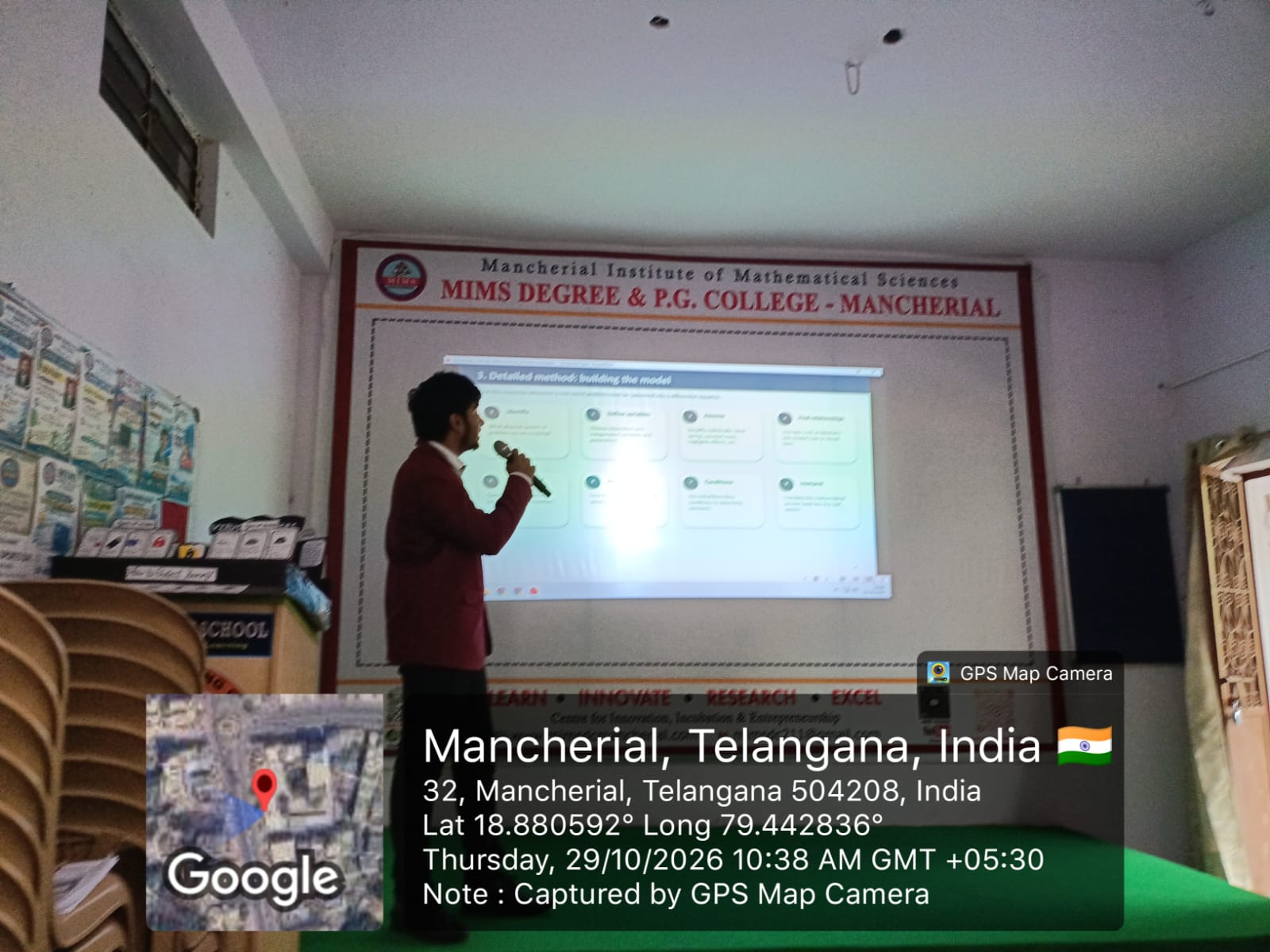
It allows scientists, engineers, and analysts to simulate behaviors, test hypotheses, and predict future outcomes under various conditions without physical experimentation.
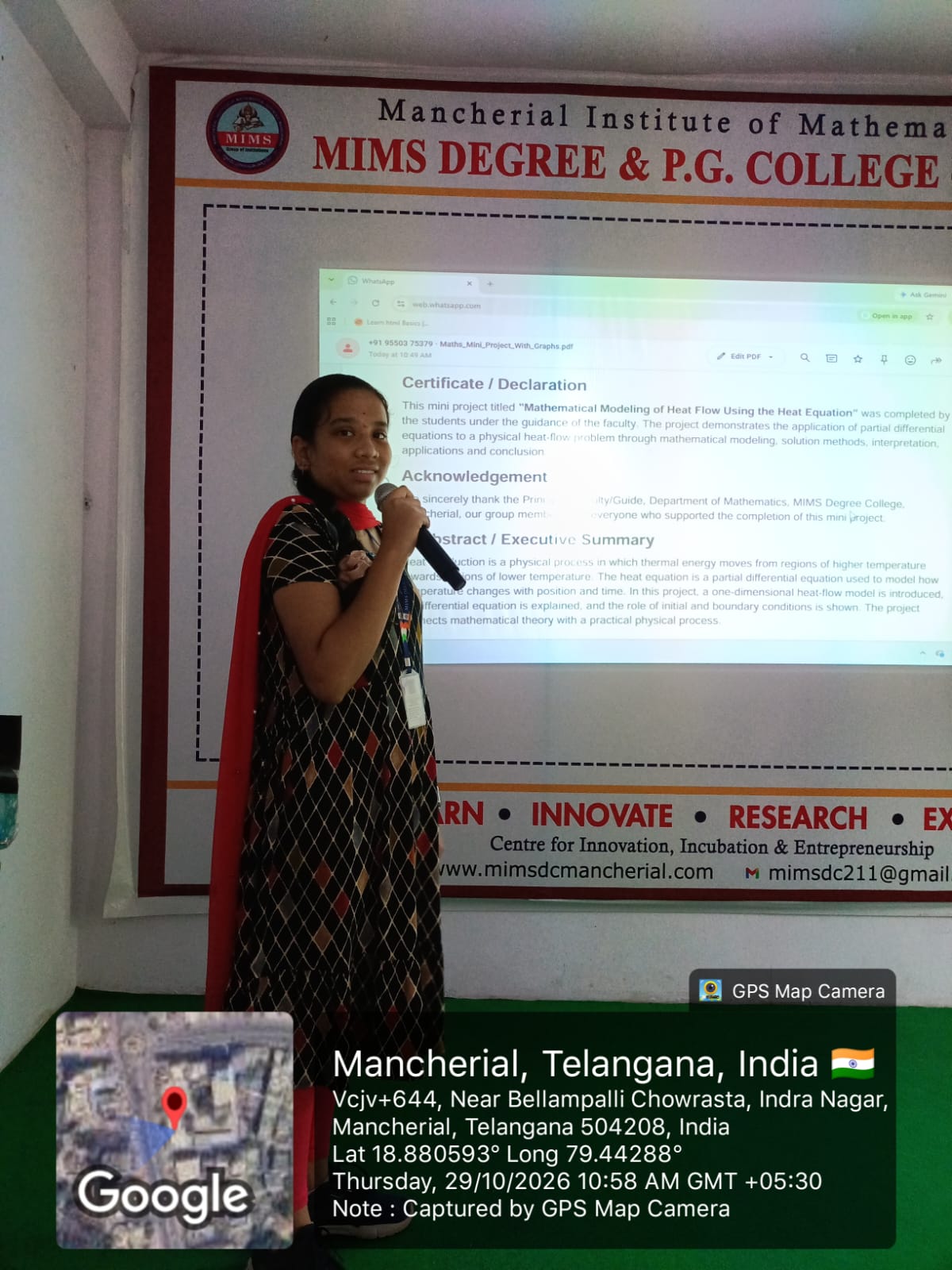
It is the process of converting real-world systems, problems, or physical phenomena into abstract mathematical frameworks using equations, variables, and algorithms.
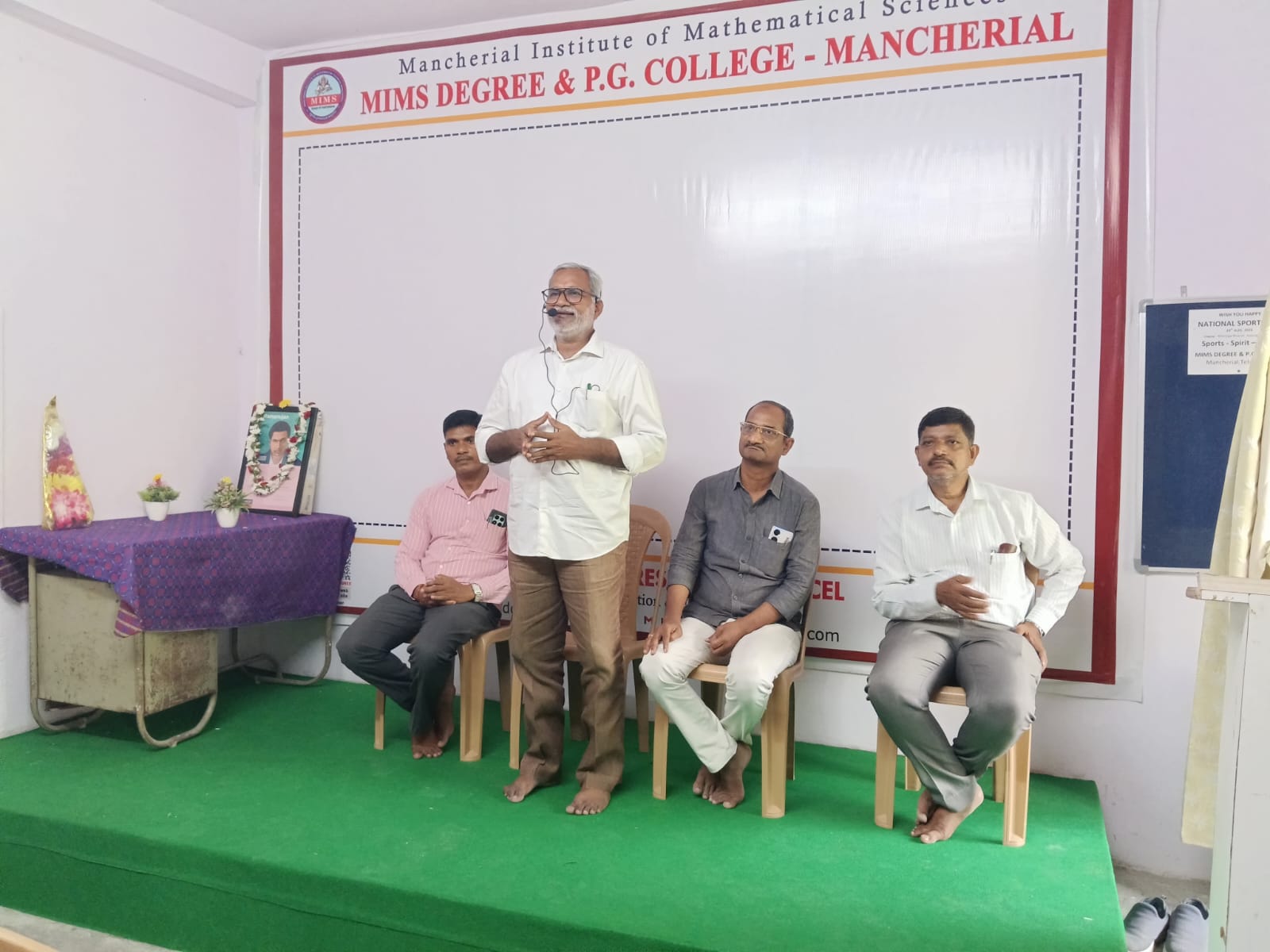
Guest Lecture Inauguration and Dignitaries :The photograph shows the resource person and faculty members participating in the guest lecture programme at MIMS Degree College, Mancherial. The resource person is addressing the gathering, while the faculty members are seated on the dais. The session provided an opportunity for academic interaction, knowledge sharing, and enrichment of students’ mathematical learning.
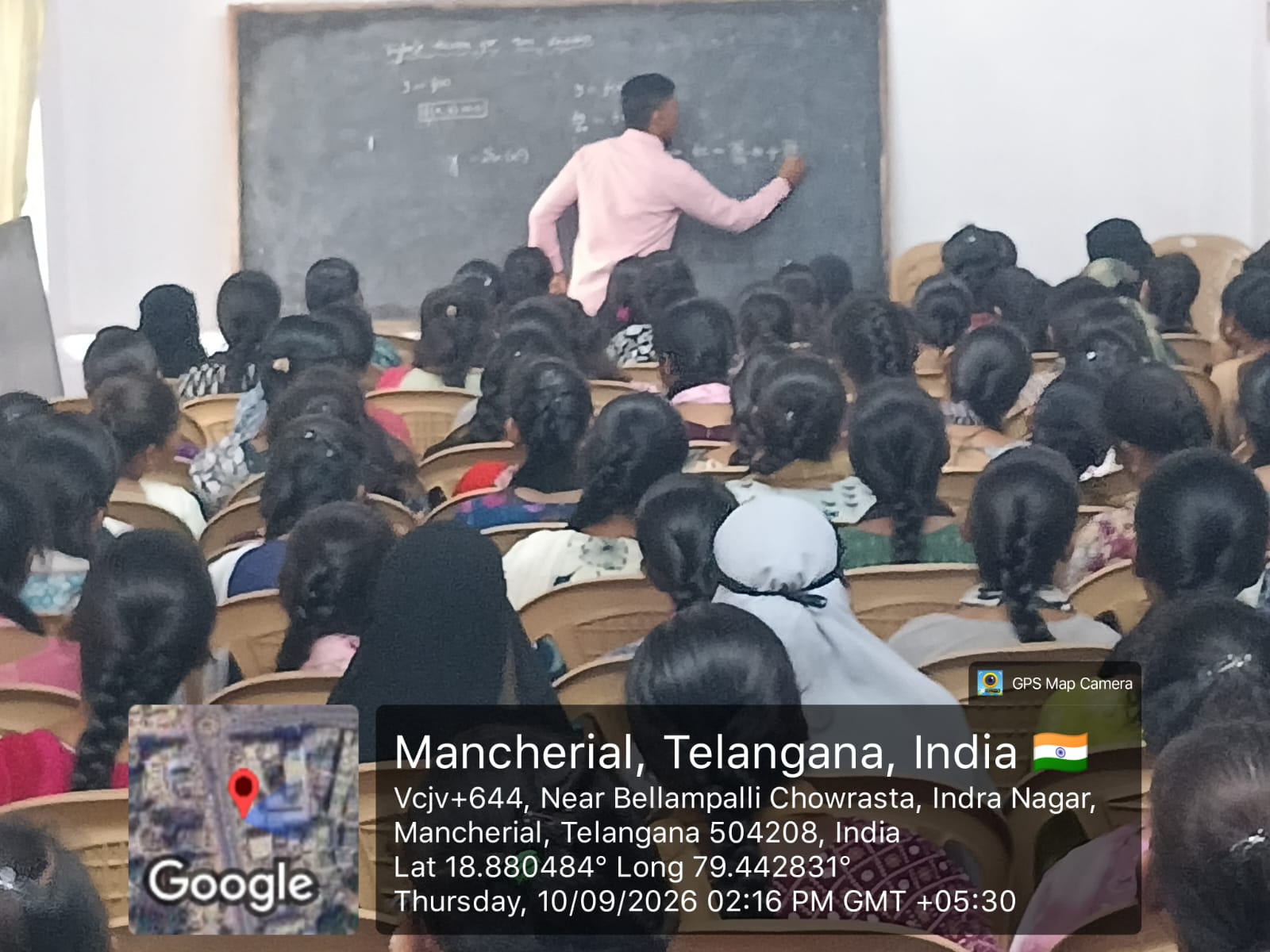
Classroom Teaching and Student Participation :The photograph captures the resource person explaining mathematical concepts on the blackboard to second-year B.Sc. students. Students are seated attentively and following the explanation of Taylor’s Theorem. The session encourages active listening, conceptual understanding, and the development of analytical and problem-solving skills.
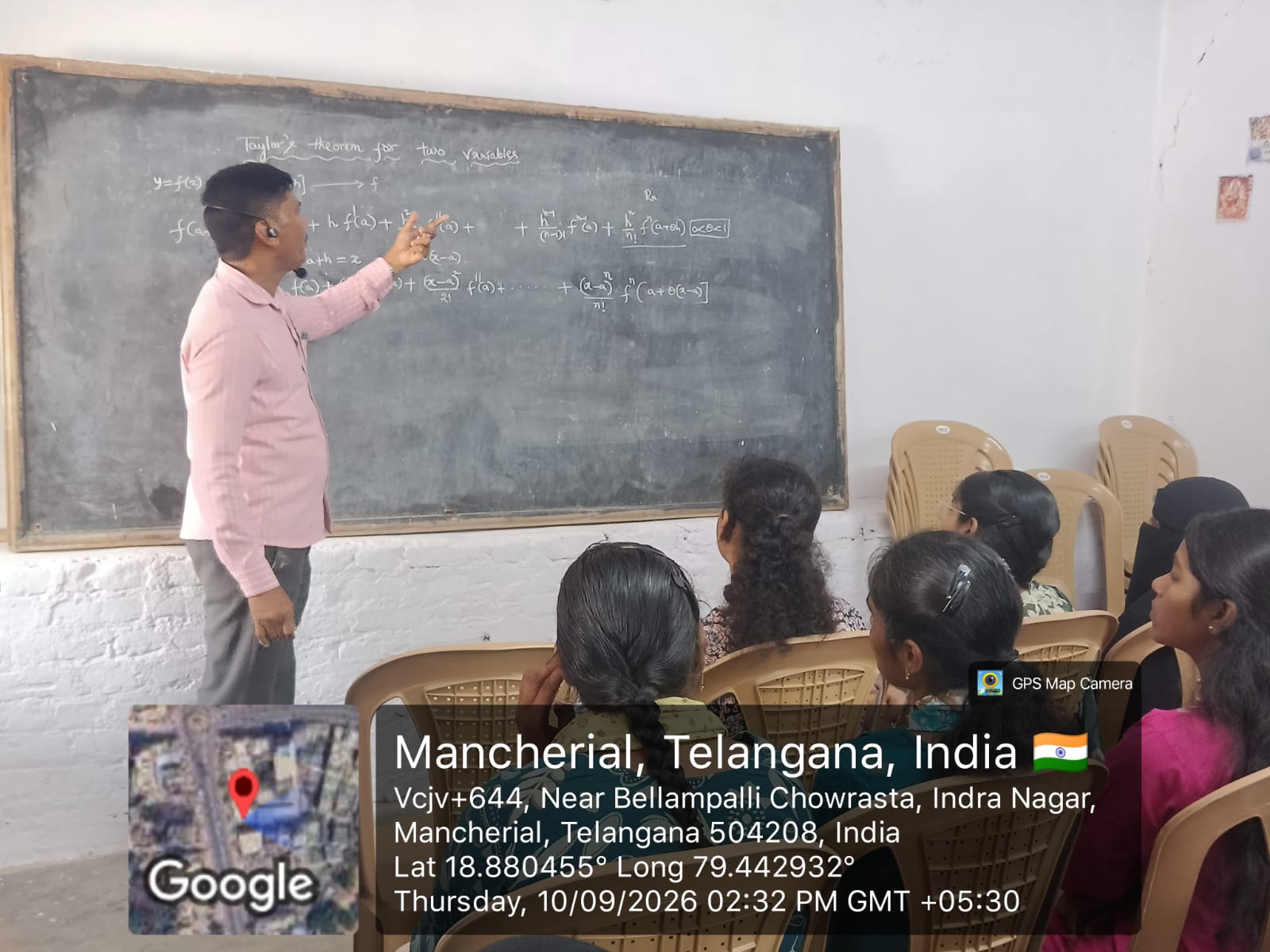
Explanation of Taylor’s Theorem :The resource person, T. Gangaiah Garu, is explaining Taylor’s Theorem using the blackboard. He discusses the mathematical expansion of functions and illustrates the theorem through formulas and derivations. This interactive teaching approach helps students understand the theoretical concepts and the step-by-step procedure involved in applying Taylor’s Theorem. Photo 3: Classroom T
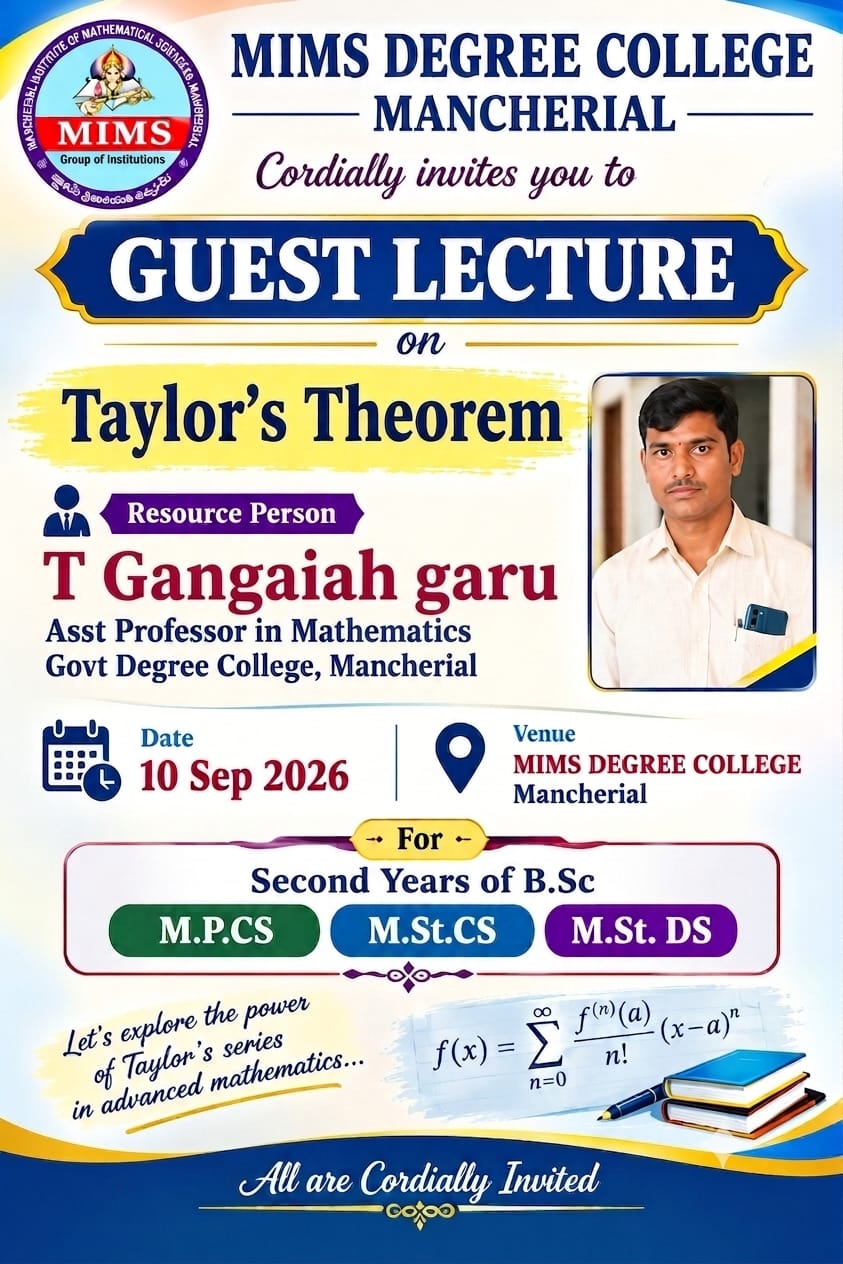
Guest Lecture Poster :The poster announces a guest lecture on “Taylor’s Theorem” organized by the Department of Mathematics, MIMS Degree College, Mancherial, on 10 September 2026. The resource person was T. Gangaiah Garu, Assistant Professor in Mathematics, Government Degree College, Mancherial. The lecture was intended for second-year B.Sc. students of M.P.CS, M.St.CS, and M.St.DS.
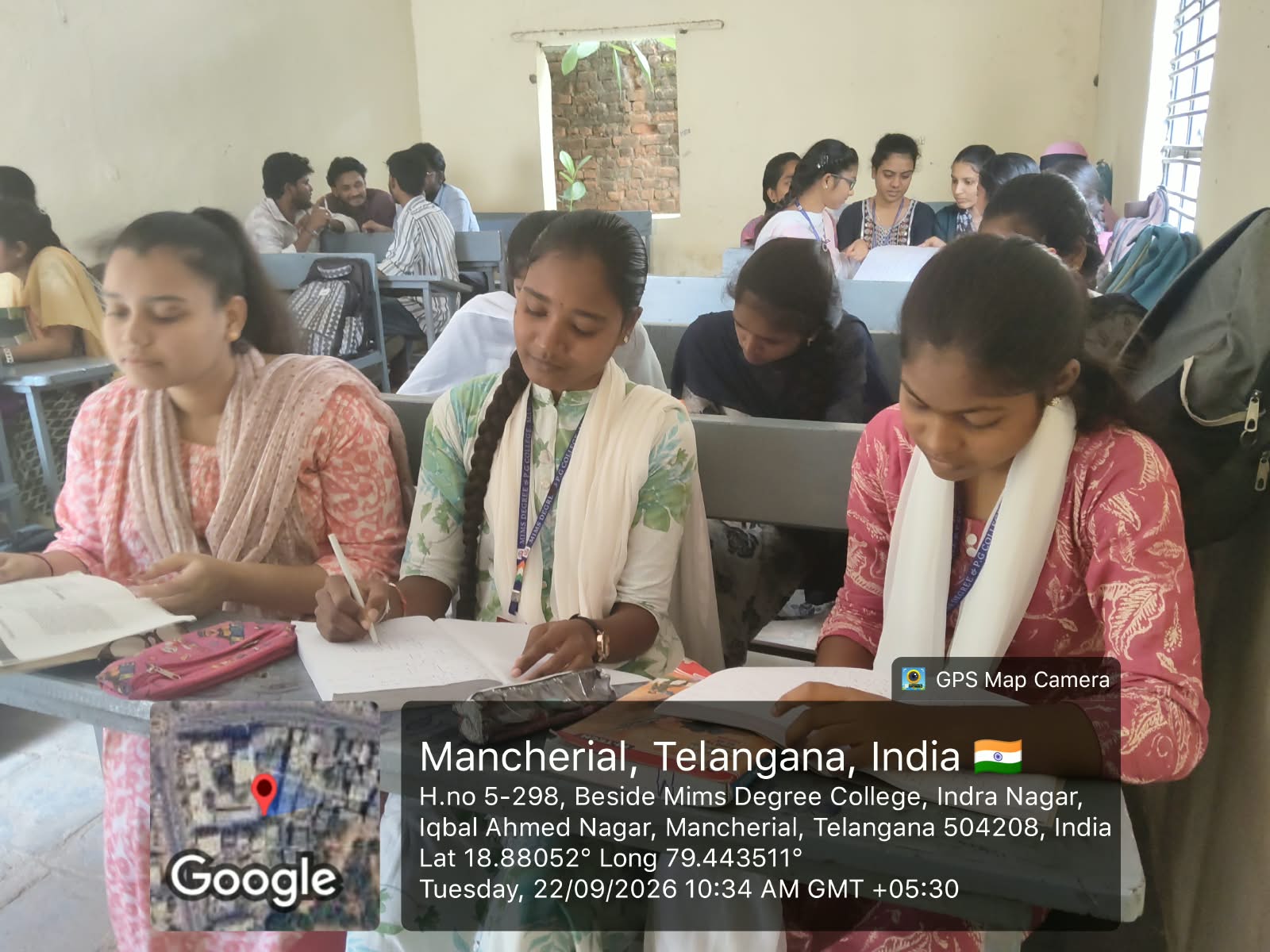
Focused Analysis & Study Material Consultation Students seated in the front rows are reviewing study materials and written notes together while discussing technical concepts. This emphasizes the practical application of theoretical formulas, problem-solving techniques, and logical reasoning required in linear algebra.
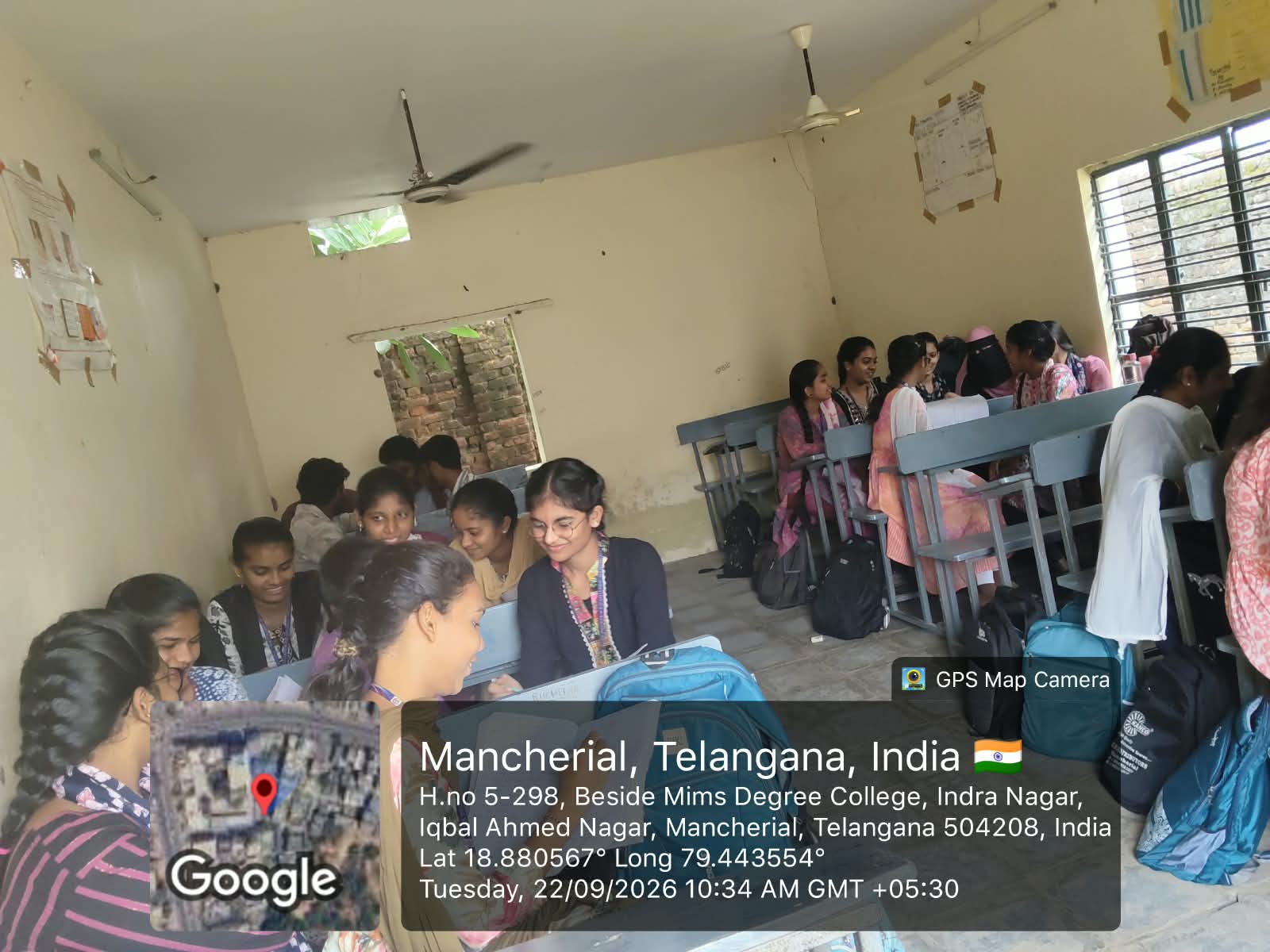
Classroom-Wide Group Discussion Activity A broader view of the classroom showing multiple student teams concurrently participating in group discussions. Students are actively engaged in dialogue and referring to academic materials to explore the practical significance of linear algebra across various science and engineering disciplines.
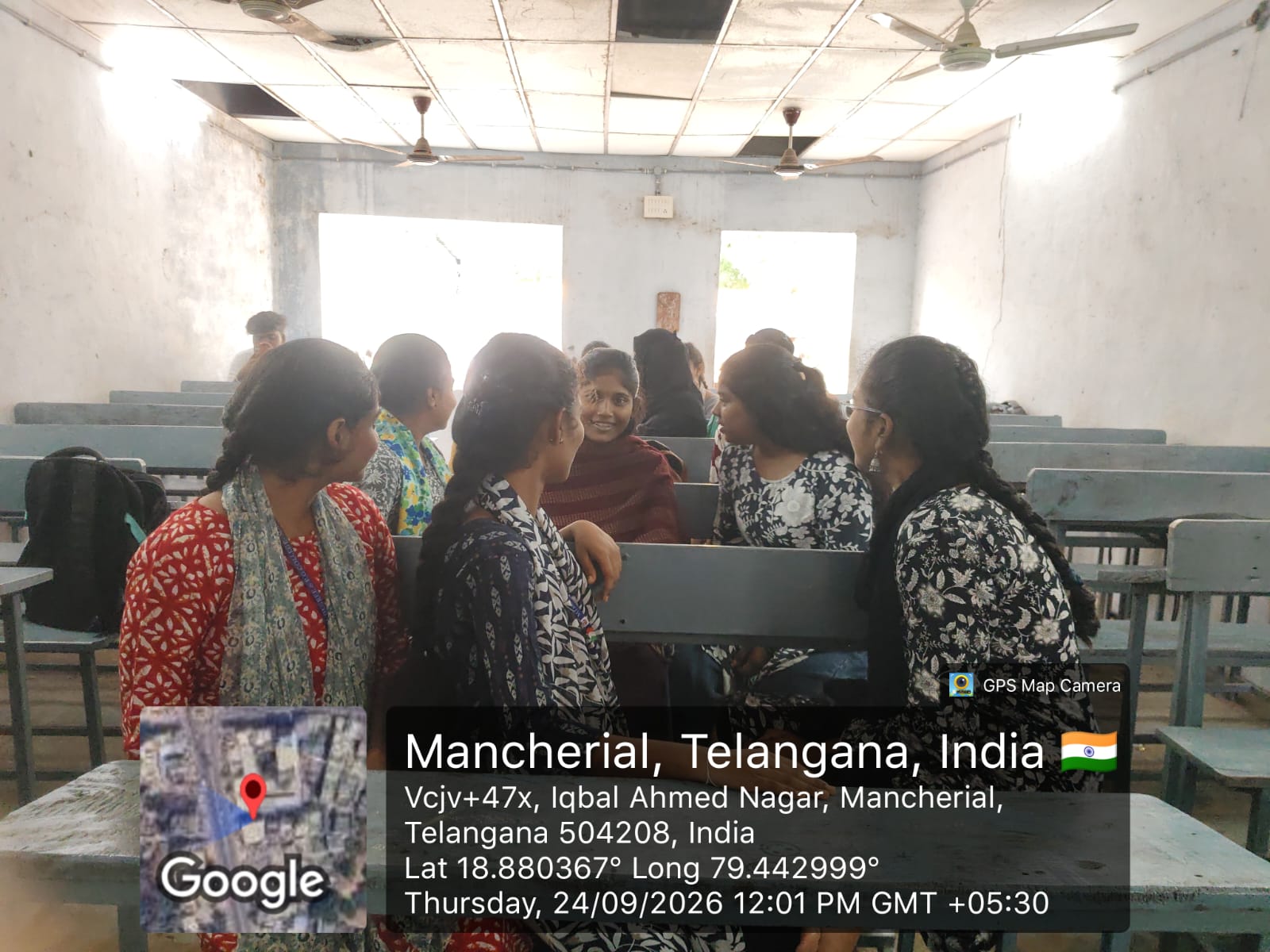
Interactive Brainstorming on Linear Transformations A close-up view of group members actively conversing and sharing ideas. Students are exchanging perspectives on key concepts like matrices, linear transformations, and system equations, demonstrating real-time collaborative learning and peer interaction.
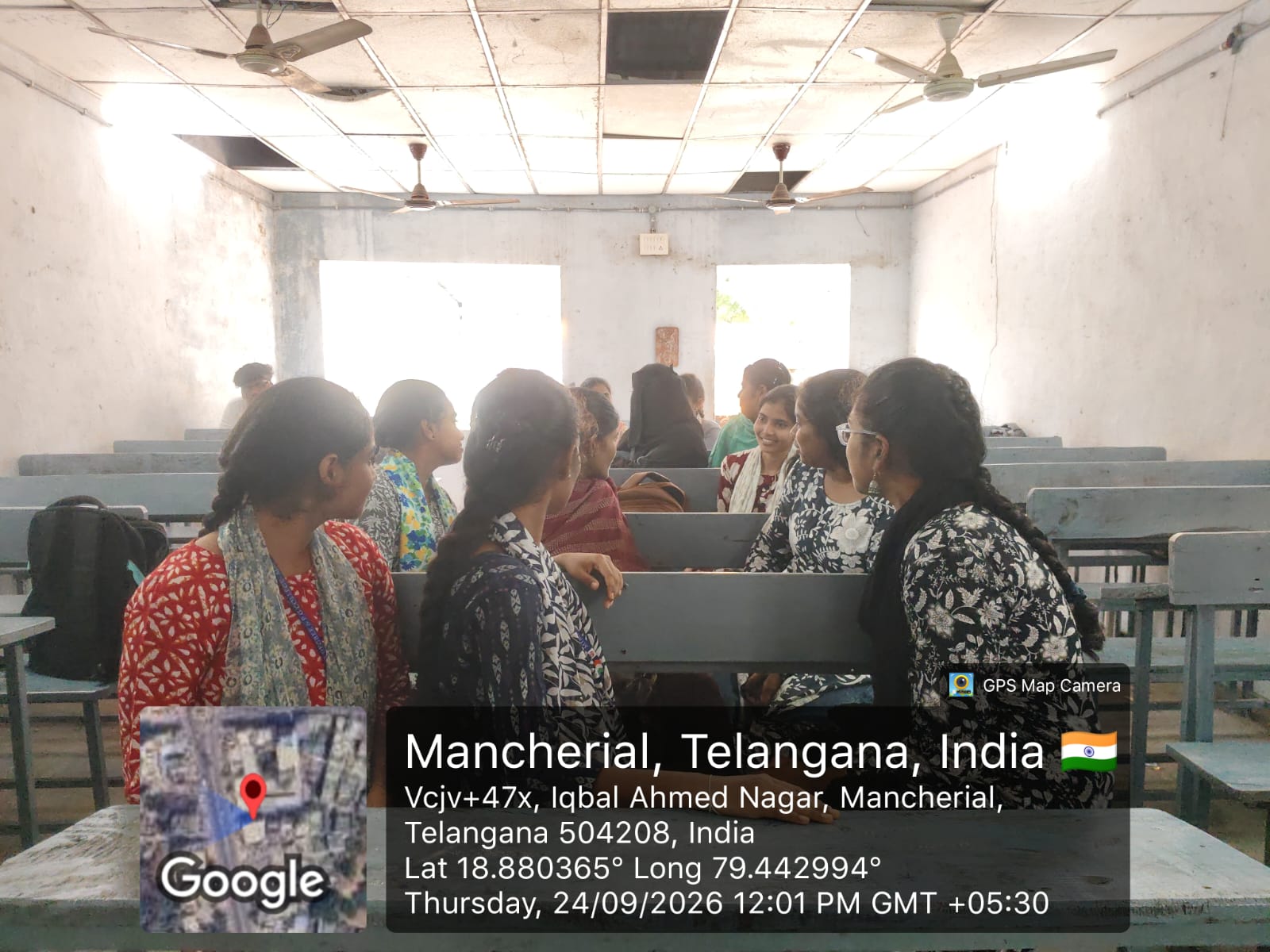
Peer Discussion on Vector Spaces & Real-World Applications Students are actively engaged in face-to-face interaction across classroom desks, sharing points on how linear algebra forms the groundwork for computational algorithms. The discussion captures students collaborating to explain how mathematical concepts like vector operations translate into modern technology.

A wide view of the classroom showing multiple small student clusters actively engaged in group discussions. The students, dressed in maroon blazers and white uniforms, are collaborating in pairs and small groups, exchanging ideas and key points on how calculus principles like rates of change and integration apply to engineering and physics. 3
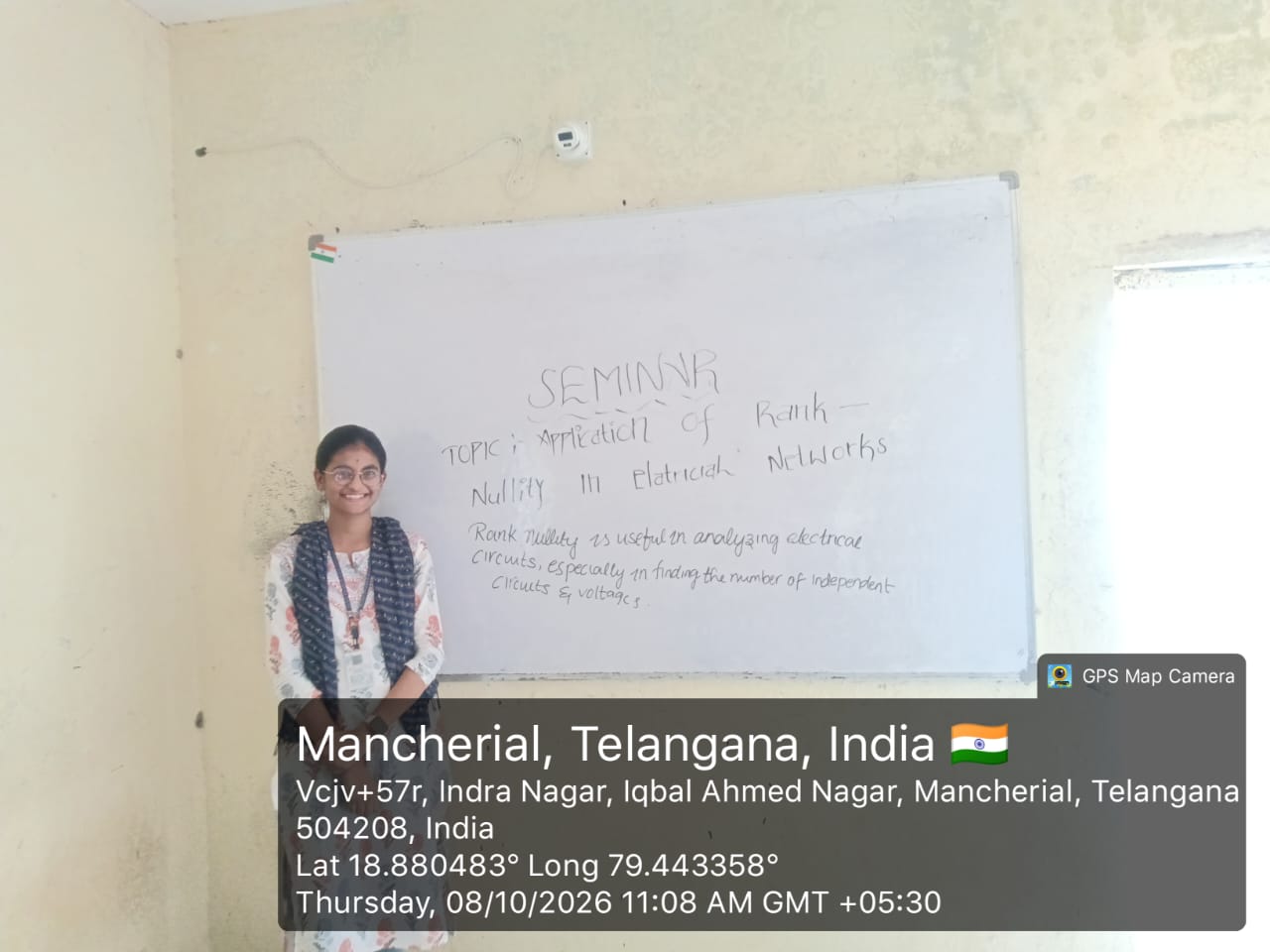
Another participant standing beside the board displaying the introductory definition of rank-nullity in electrical network analysis.
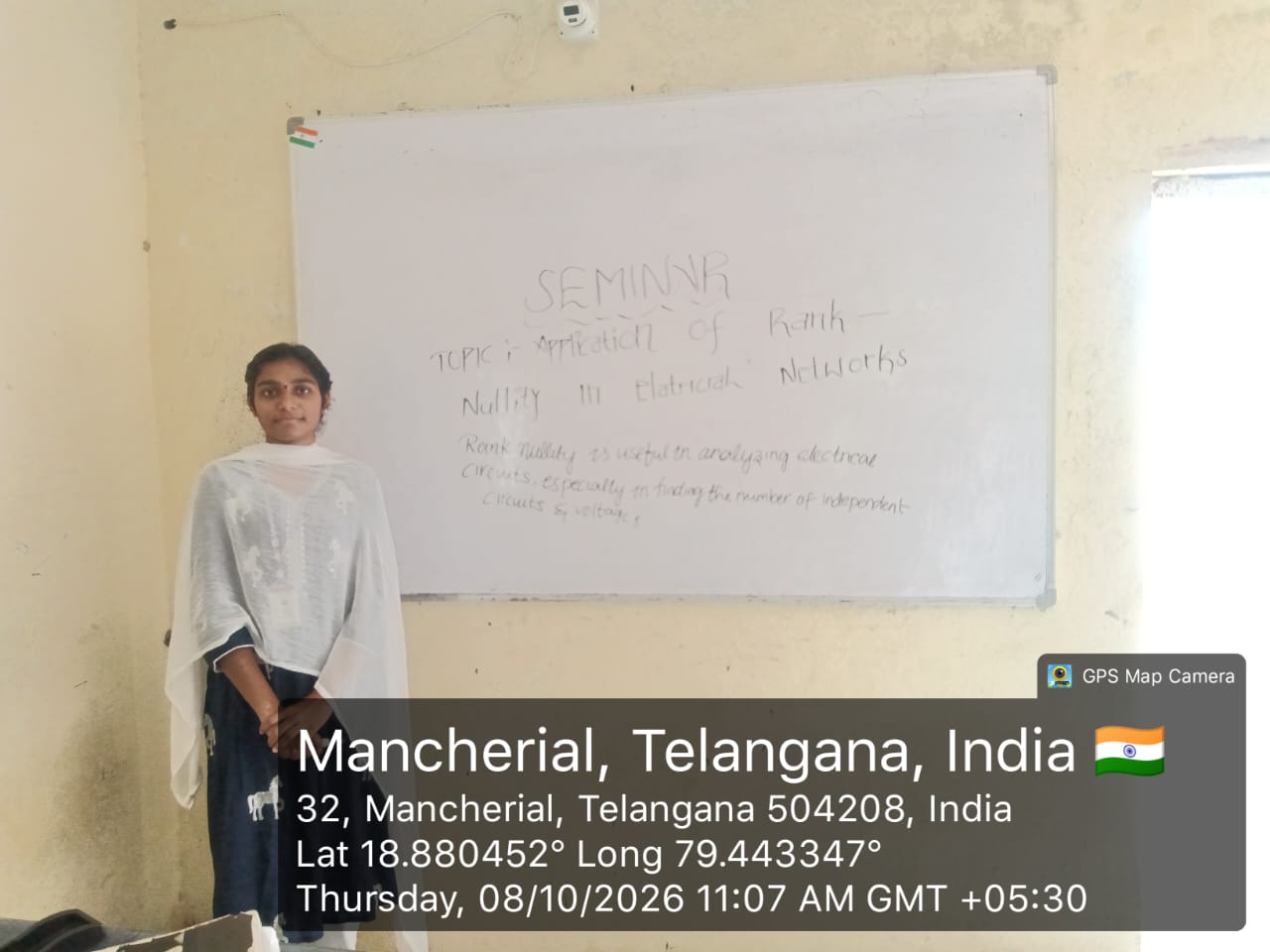
Rank-nullity is useful in analyzing electrical circuits, particularly in finding the number of independent circuits and voltages.
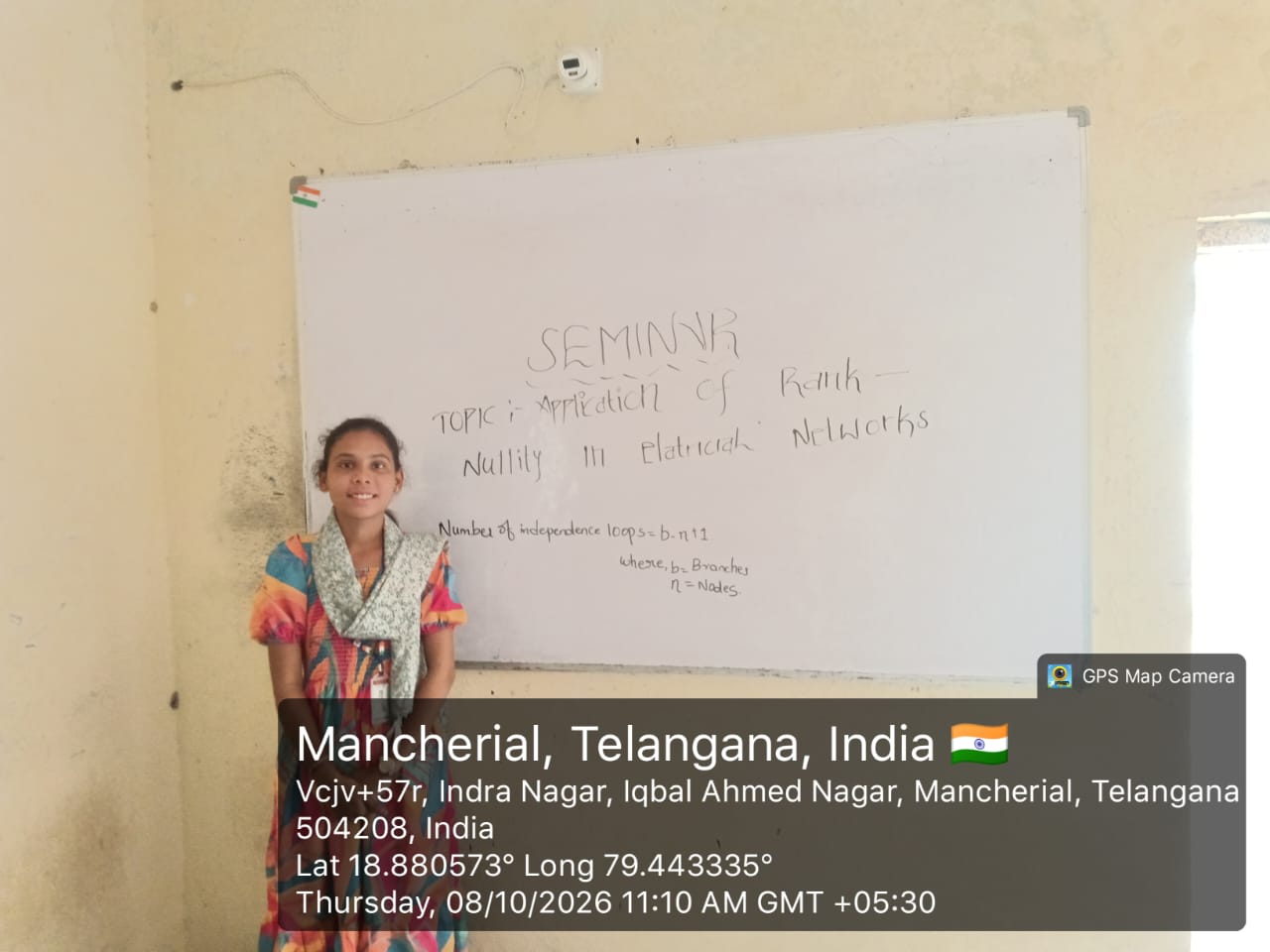
student presenting the mathematical formulation on the board, showing the calculation for independent loops: Number of independent loops = b - n + 1 (where b represents branches and n represents nodes).
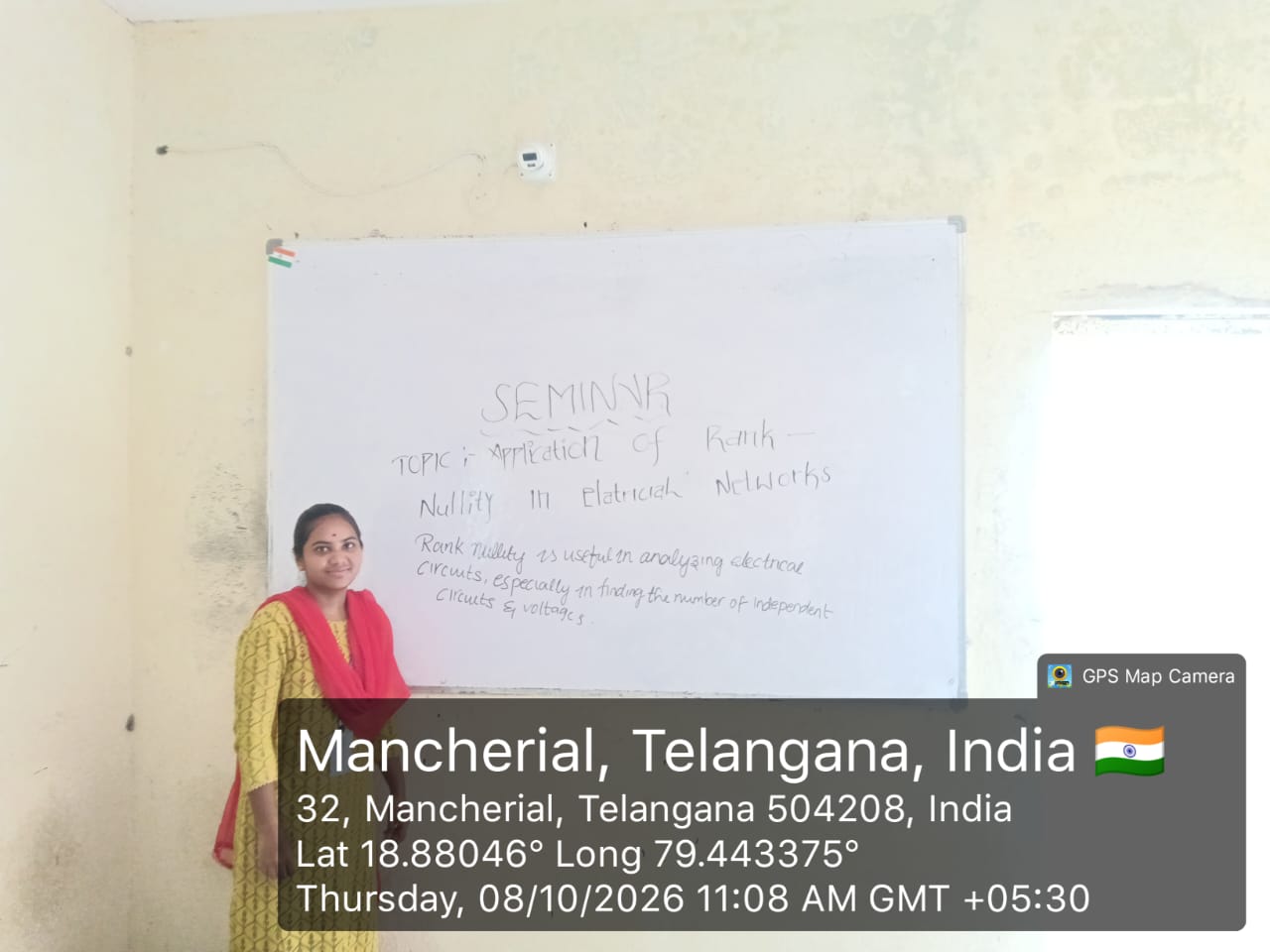
student posing next to the whiteboard, which introduces the seminar topic. The board outlines how rank-nullity is utilized in analyzing electrical circuits, specifically to determine independent circuits and voltages.
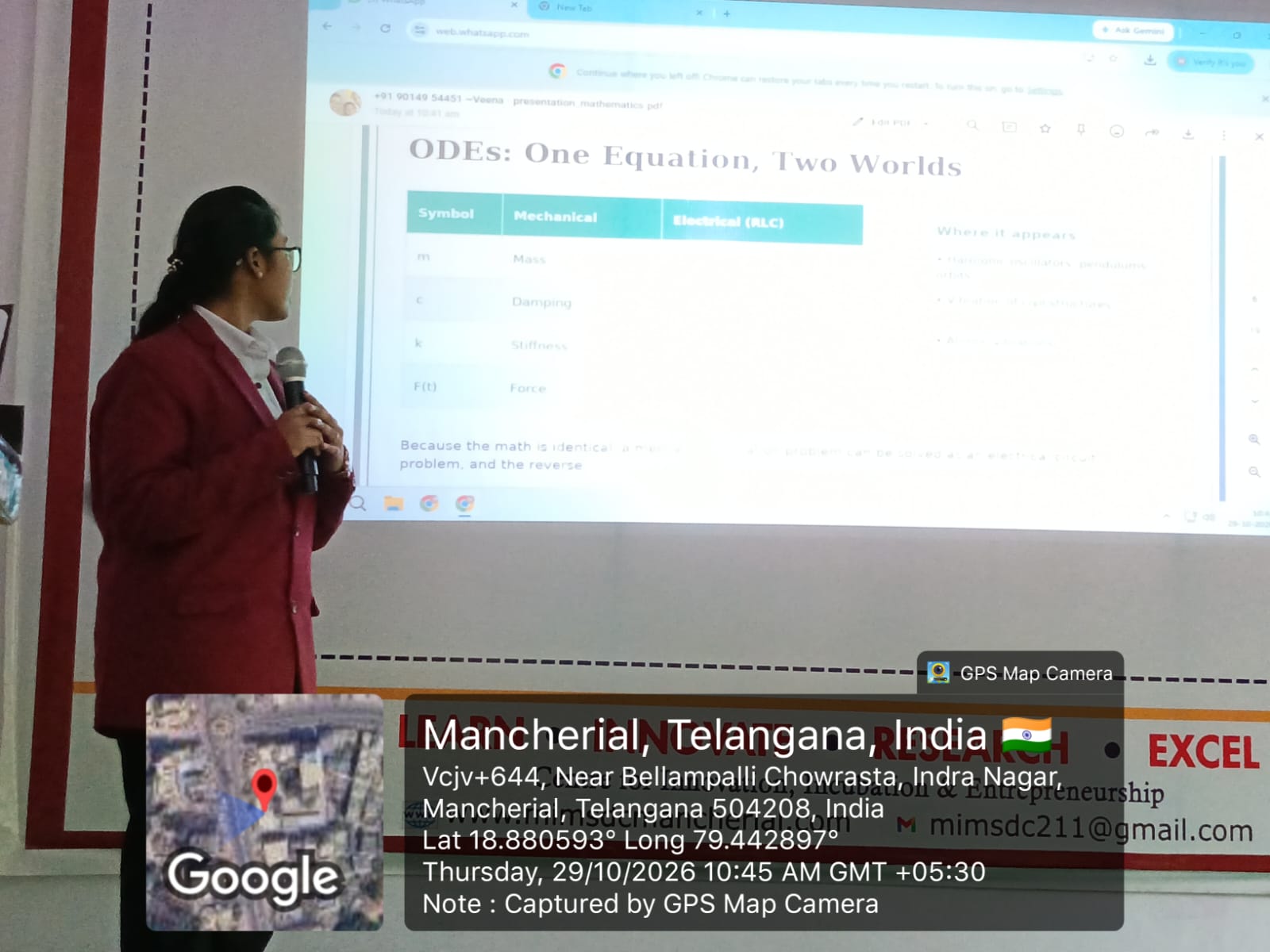
A slide comparison titled
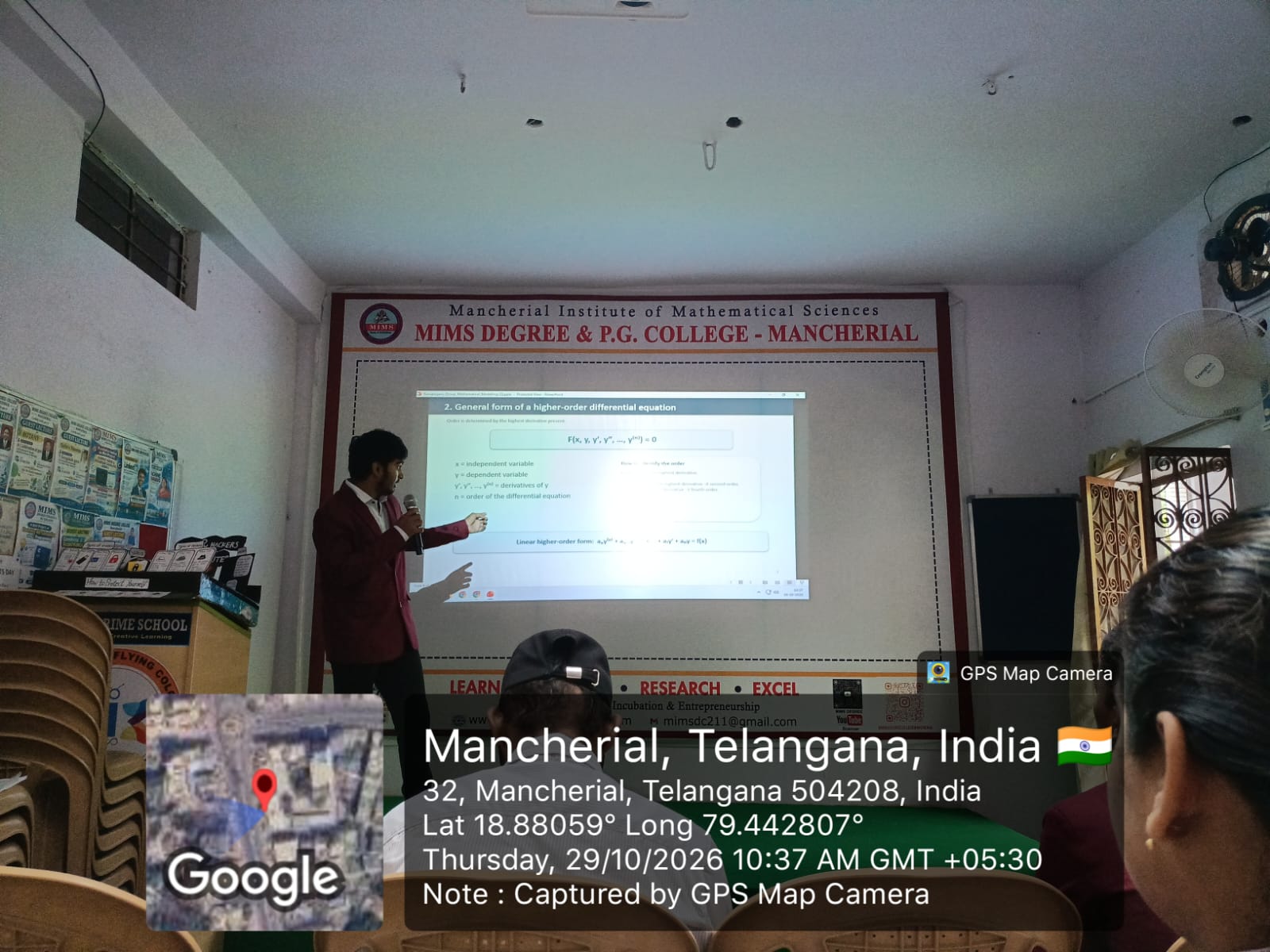
The presenter explaining Ordinary Differential Equations (mx'' + cx' + kx = F(t)), demonstrating how math models mechanical systems, mass, damping, and force in physics and engineering applications.
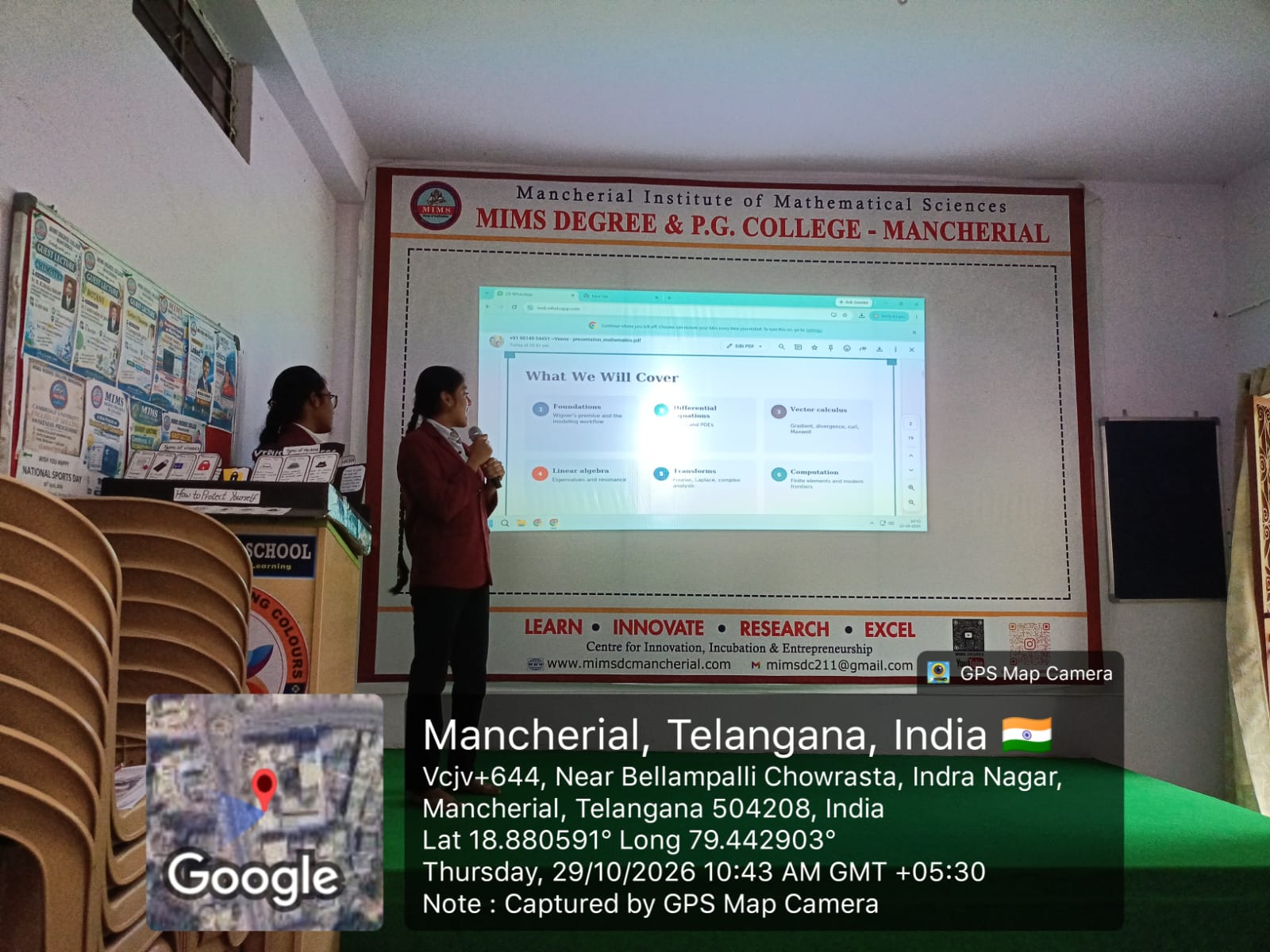
A student presenter standing on stage at MIMS Degree & P.G. College in Mancherial, introducing an overview slide titled
The seminar enhances students' understanding of theoretical concepts and their applications in solving mathematical problems.
Students learn to find partial derivatives of implicit functions using differentiation techniques.
It discusses the conditions under which a dependent variable can be expressed as an implicit function of independent variables.

The seminar explains the concept of implicit functions and their importance in mathematical analysis.
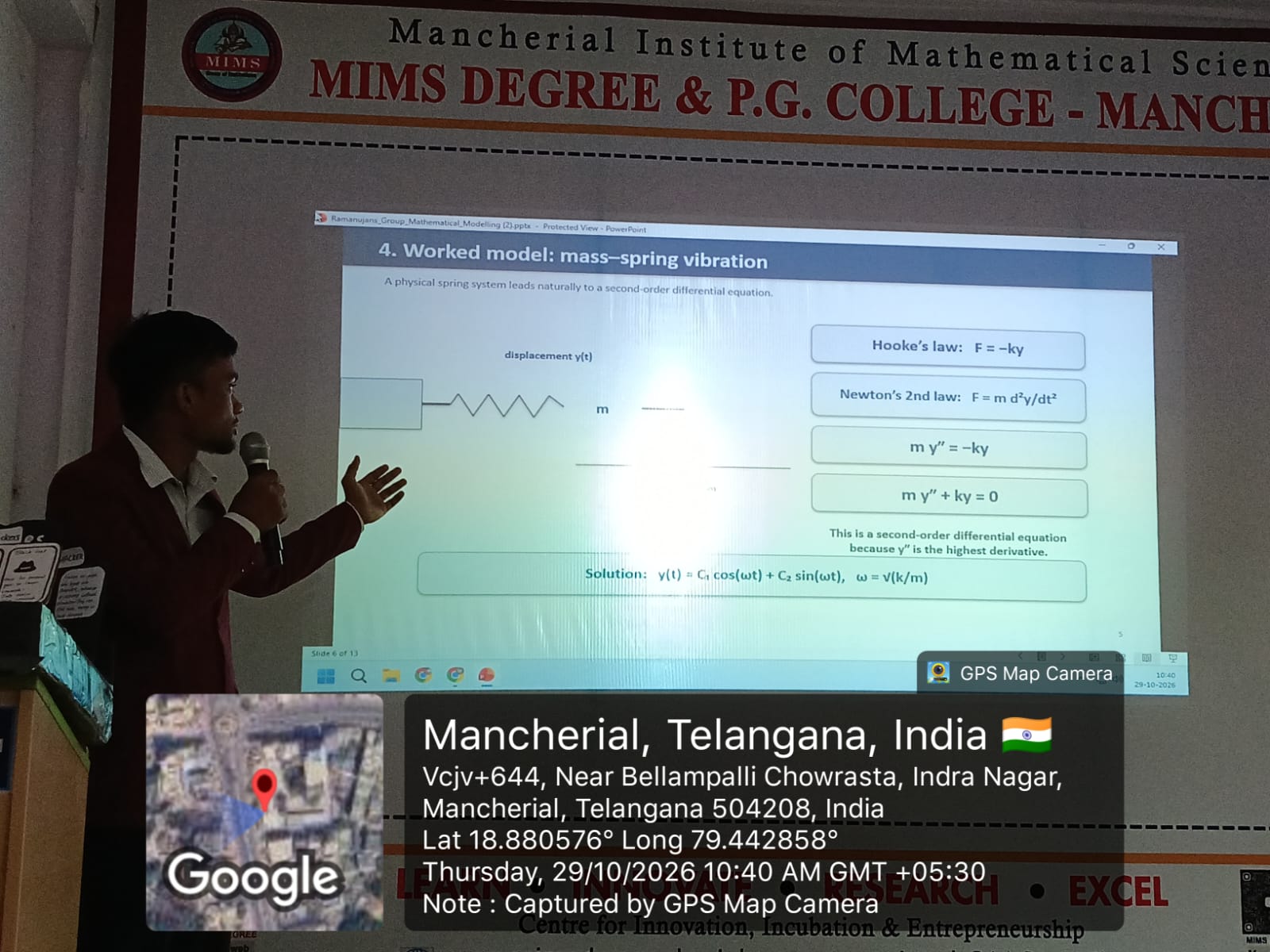
A practical walkthrough of a second-order differential equation applied to a physical mass-spring system. The presenter demonstrates how Hooke's Law and Newton's Second Law combine to solve for system displacement y(t).
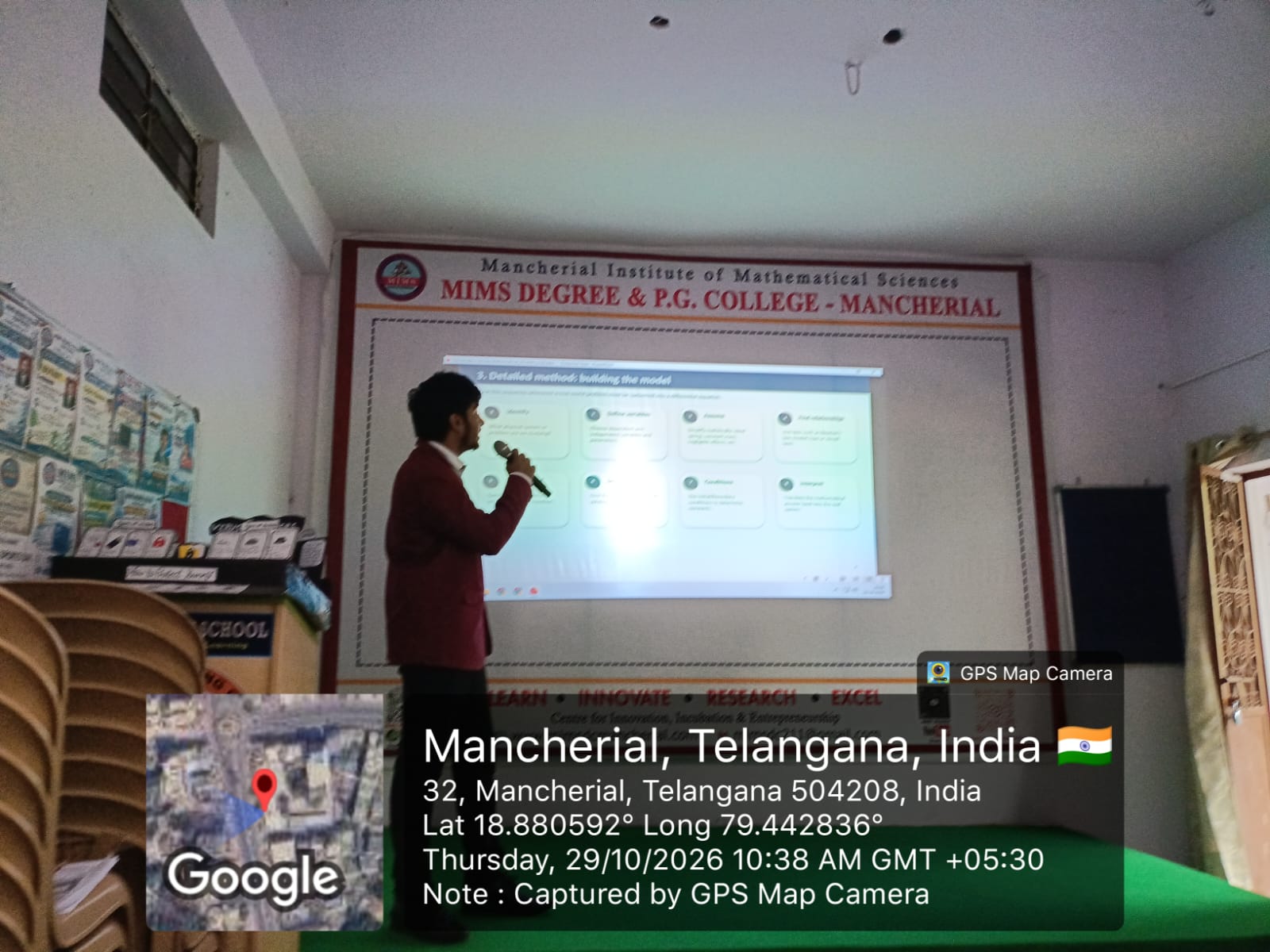
A detailed comparison table mapping mechanical system parameters (mass, damping, stiffness, force) to their electrical equivalents (RLC circuit counterparts). The speaker highlights how identical mathematical structures can describe entirely different physical domains.
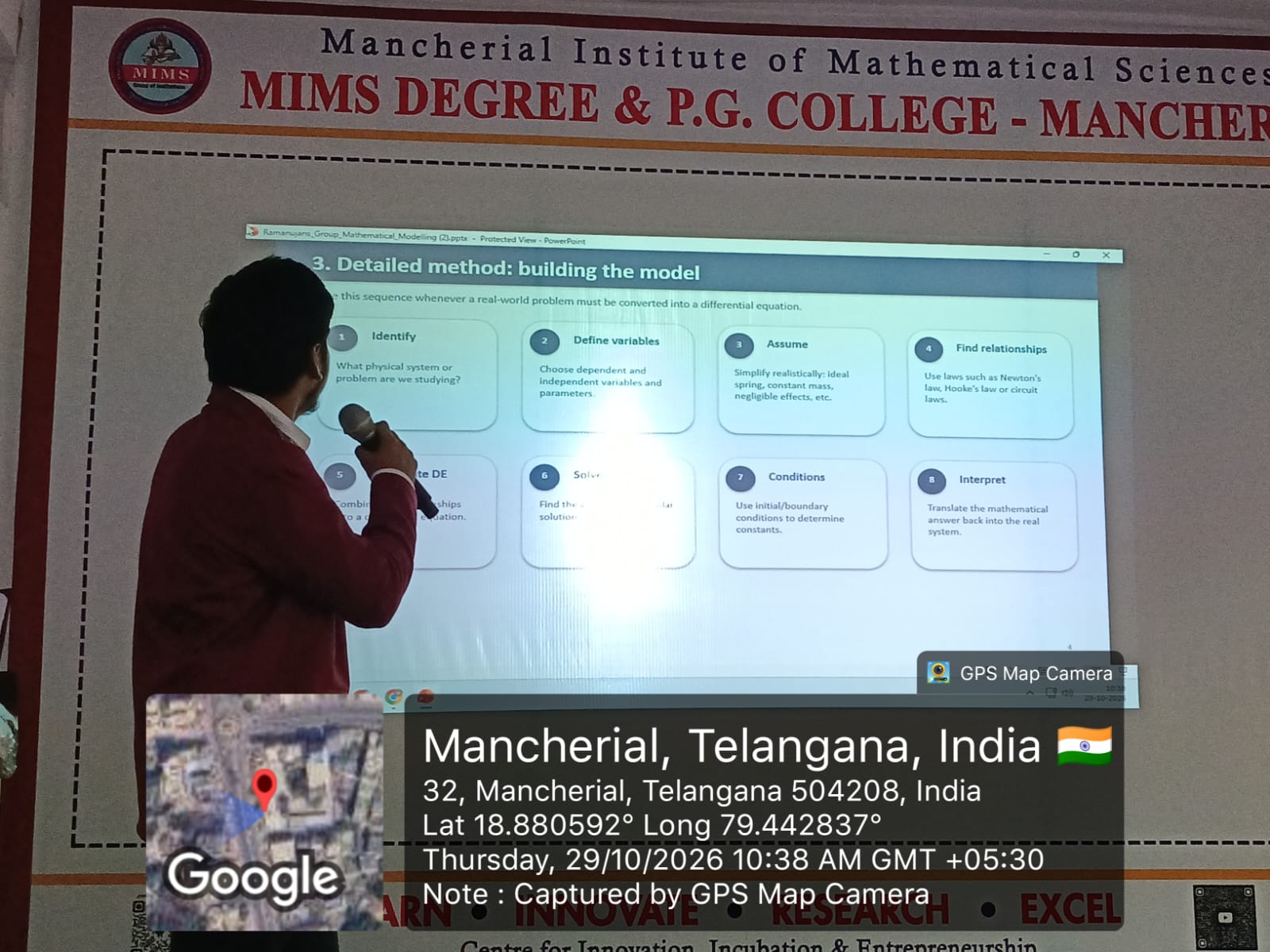
The presenter explains the general equation for a damped driven harmonic oscillator (mx'' + cx' + kx = F(t)). This slide breaks down the roles of mass (m), damping (c), stiffness (k), and force (F(t)) in modeling physical behavior over time.
A student presenting the overall structural agenda of the mathematical modelling project. The slide outlines core topics such as Foundations, Differential Equations, Vector Calculus, Linear Algebra, Transforms, and Computation.
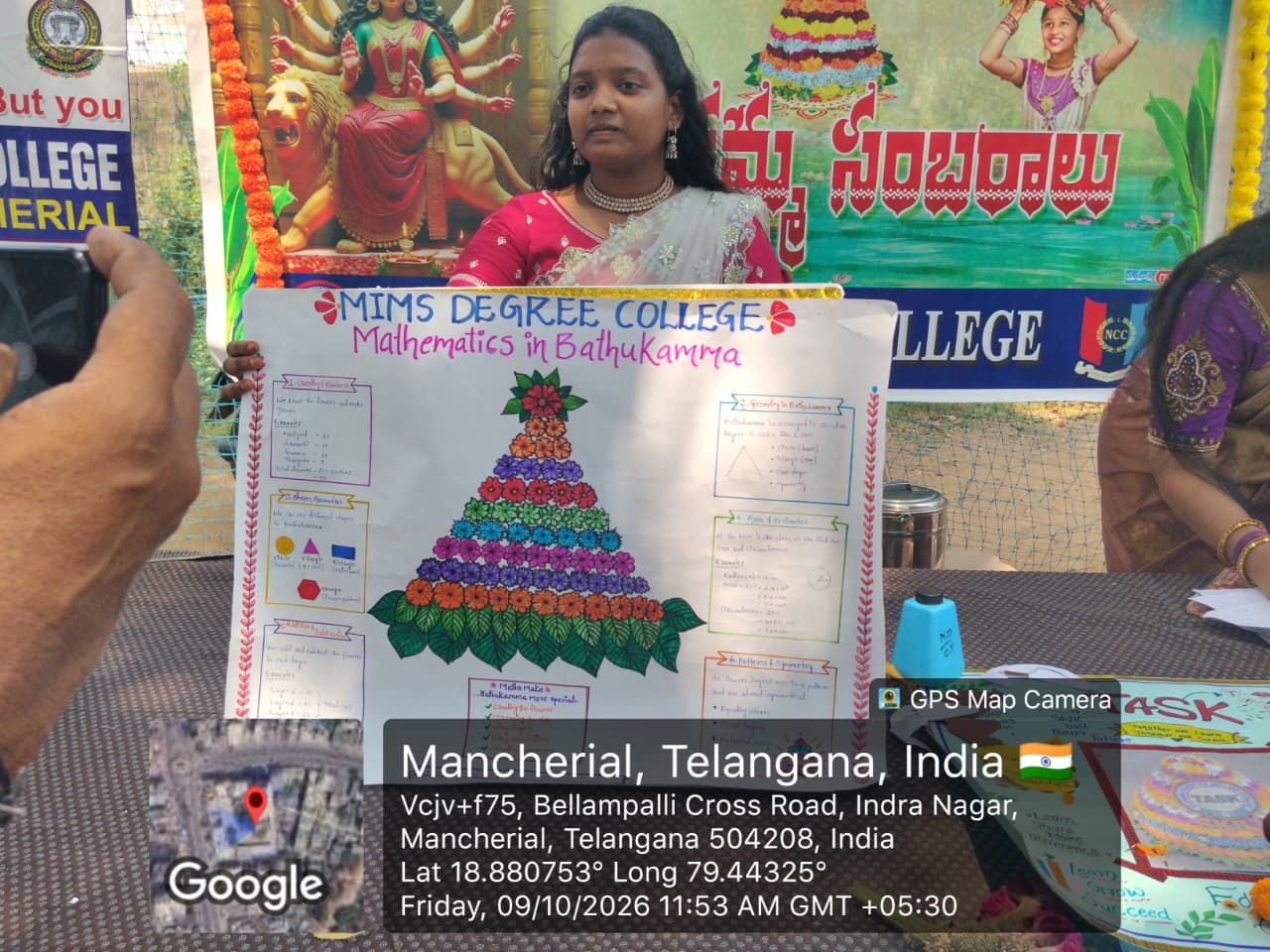
Context & Presentation: A close-up view of the central project chart titled
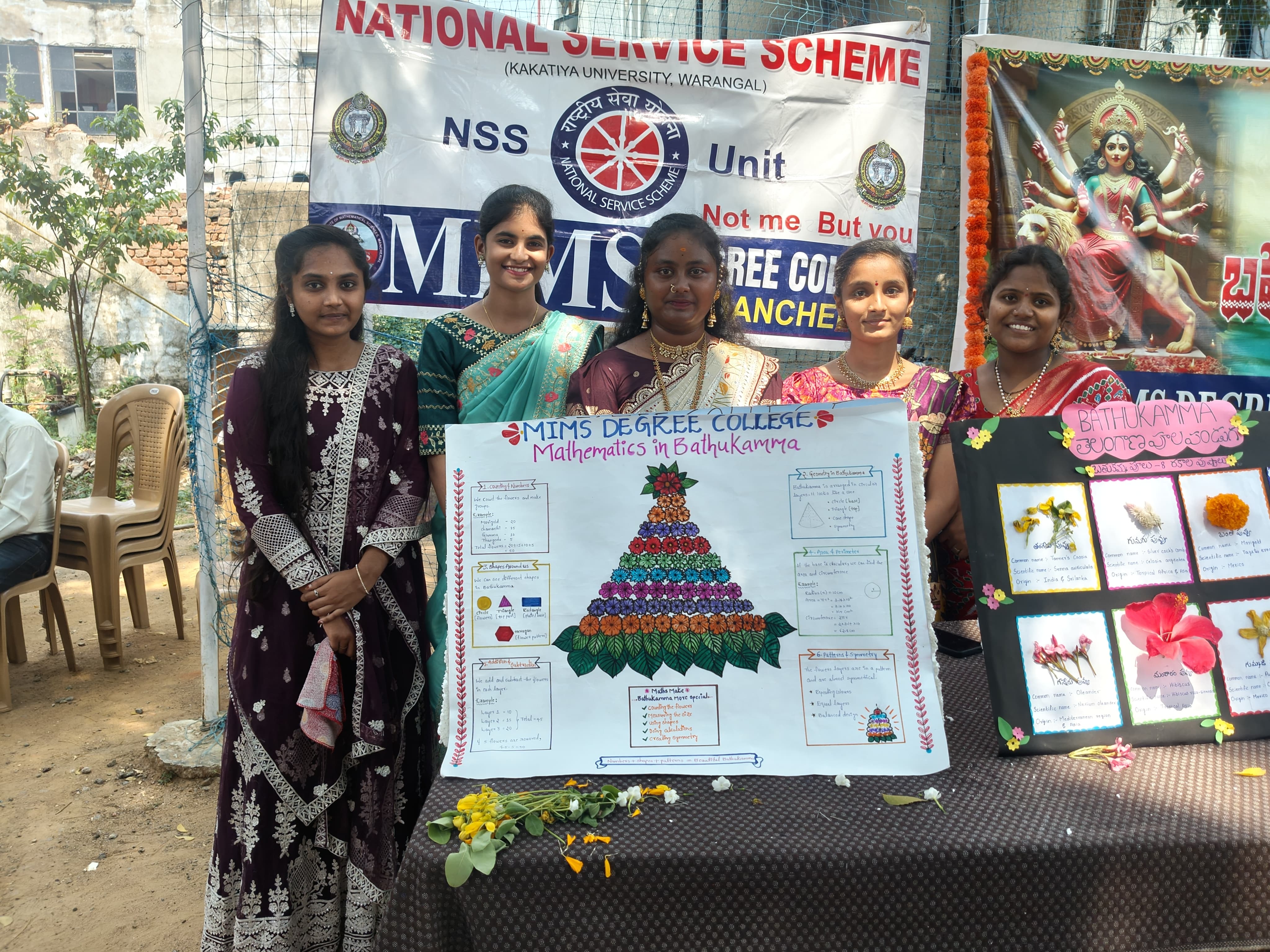
Context & Presentation: Students and faculty of MIMS Degree College stand proudly alongside an NSS banner during a cultural and academic exhibition. They are showcasing handmade project charts detailing